Case Studies
(1.) LOUIS VUITTON v. MY OTHER BAG
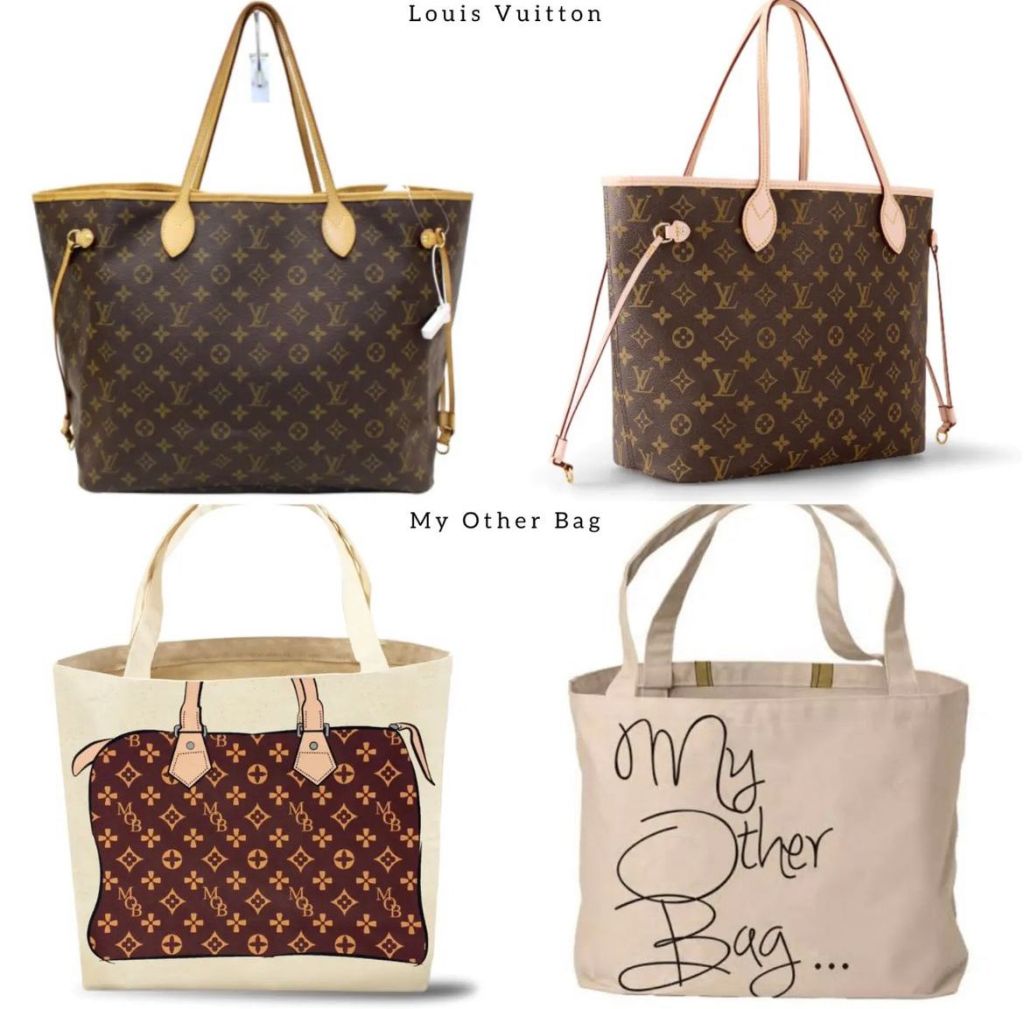
Louis Vuitton is no stranger to trademark disputes. As a manufacturer of handbags, wallets, and other luxury goods, the company has its hands full just addressing counterfeit products.
The fashion giant sued a one-woman company whose product, a tote bag, poked fun at Louis Vuitton’s famous handbag by scrawling the words “My Other Bag” on one side of the tote and displaying an altered version of the famous Louis Vuitton pattern, altered to replace LV with MOB, on the other.
Louis Vuitton sued My Other Bag, alleging trademark infringement, trademark dilution (a legal concept that prohibits unauthorized uses of famous marks to prevent associations that reduce their distinctiveness and uniqueness), false designation of origin, and copyright infringement.
Judge Jesse M. Furman of New York State’s southern district ruled that My Other Bag’s canvas totes, which feature illustrations of Louis Vuitton purses, are simply parodies and therefore do not serve as sources of trademark infringement or dilution.
A claim of “parody” is not a defense in and of itself, but generally qualifies as a type of fair use for copyright infringement and for claims of dilution. Section 43(3) of the Lanham (Trademark) Act, 1946 also specifically identifies “fair use” to include uses that are “parodying, criticizing, or commenting upon a famous mark.”
Furman wrote in the decision: “MOB’s use of Louis Vuitton’s marks in service of what is an obvious attempt at humor is not likely to cause confusion or the blurring of the distinctiveness of Louis Vuitton’s marks, if anything, it is likely only to reinforce and enhance the distinctiveness and notoriety of the famous brand.”
The court decided so because there was an arguable basis for each of Louis Vuitton’s unsuccessful arguments, the litigation of the case was not exceptional under the Lanham Act and also did not merit any award of fees for the copyright claims.
(2.) GUCCI v. CUGGL:
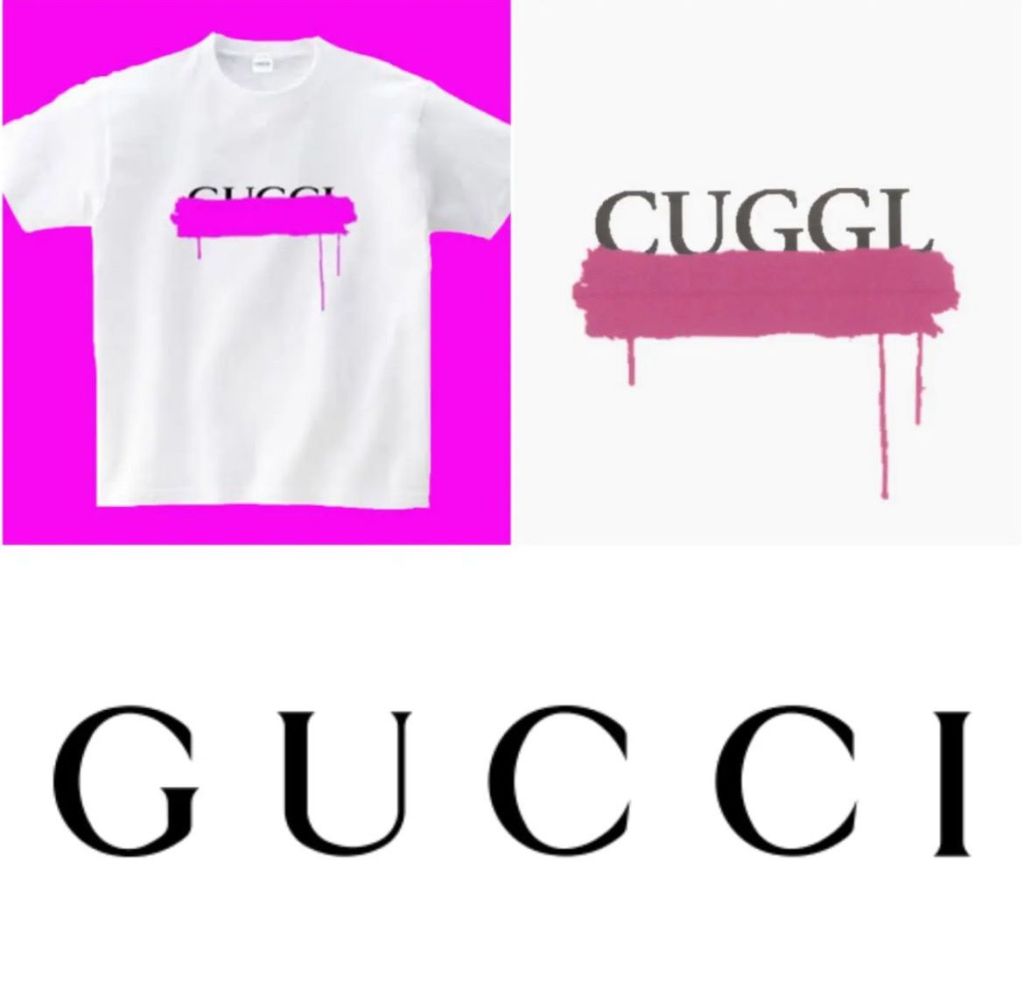
Nobuaki Kurokawa, an entrepreneur from Osaka, registered a trademark for the name “CUGGL”. The firm started producing T-shirts with its registered mark partially hidden, giving the impression that the Gucci trademark was redacted using hot pink paint.
According to the Japanese law firm Marks IP, Nobuaki Kurokawa applied for a trademark for CUGGL in October 2020. Gucci was a little slow to realise, but when it did, it lodged a complaint accusing Kurokawa of trademarking his CUGGL mark with “malicious intent to free-ride on the goodwill and reputation” of its brand.
The Italian fashion house argued that the opposed mark shall not be approved for registration since in contravention of Article 4(1)(vii), (xv), and (xix) of the Trademark Law especially because of the similarity and likelihood of confusion with famous fashion brand “GUCCI”.
Gucci tried to get the trademark cancelled. It argued that CUGGL was “identical with, or similar to, a trademark which is well known among consumers in Japan or abroad” and that
the likeness could damage its own reputation and deceive shoppers since it was being used in a fashion context.
But the argument didn’t sway the Japan Patent Office, it rejected the comparison between the Gucci and CUGGL marks, saying that it sees no resemblances “from visual, phonetic, and conceptual points of view”. It found that there was a “low degree of similarity” between the logos, so consumers were not likely to confuse them.
Kurokawa was permitted to carry on offering the shirts for sale. Kurokawa, through this litigation, proved his expertise in intellectual property law, at least within the framework of the Japanese legal system.
(3.) RAJESH MARANI V. TAHILIANI DESIGNS PVT. LTD
In this landmark case, which constitutes a significant milestone in the jurisprudence surrounding the ambit of copyright protection afforded to fashion designers concerning their “artistic work,” the plaintiff, Tahiliani Design Pvt. Ltd. instituted legal action with the primary objective of securing legal safeguards for their distinctive fashion designs and creative sketches.
The defendant, Rajesh Marani, had engaged in the unauthorized replication and imitation of the plaintiff’s designs. The pivotal inquiry before the court, therefore, pertained to the determination of whether the drawings and patterns conceived by the plaintiff possessed the requisite attributes to be classified as “artistic works” within the purview of the Copyright Act.
In this matter, the Court undertook a comprehensive examination of the evidence presented by the Plaintiff to substantiate his assertion that the clothing items he has conceptualized and crafted qualify as original artistic creations, as defined and delineated under Sections 2(i) and 2(iii) of the 1957 Act. Section 2 “artistic work” means, —
i) a painting, a sculpture, a drawing (including a diagram, map, chart or plan, an engraving or a photograph, whether or not any such work possesses artistic quality;
(iii) any other work of artistic craftsmanship;
The Plaintiff extended arguments to encompass various aspects of intellectual property, including but not limited to the drawings and sketches generated during the creative design phase, the intricate patterns and embroidery meticulously applied to the textile materials, and the promotional catalogues published under his personal brand and label.
Furthermore, the Plaintiff proffered additional elements for consideration, including the creative sketches that serve as the initial blueprints for his designs. These sketches are integral to the genesis of his clothing items and are presented as evidence of his creative process and originality.
The adjudicating panel ruled on two key determinations in the case:
Firstly, it recognizes the Plaintiffs garments as “artistic work” under Sections 2(i) and 2(iii) of the Copyright Act of 1957, granting the plaintiff specific rights and protections. This categorization affords the plaintiff certain rights and protections associated with artistic works under the aforementioned statute.
Secondly, the panel has found the defendants guilty of copyright infringement for their unauthorized use of the Plaintiffs artistic works, thereby violating the plaintiff’s exclusive rights under the same Act. Such actions constitute an infringement of the plaintiffs exclusive rights as granted by the Copyright Act of 1957.
(4.) RITIKA PRIVATE LTD. VS BIBA APPARELS PVT LTD.
230 (2016) DLT 109
The Delhi High Court adjudicated a matter between Ritika Pvt Ltd, the proprietor of the renowned brand Ritu Kumar, and Biba Apparels, owned by Biba. Ritika accused Biba of plagiarizing Ritu Kumar’s designs to manufacture clothing, so violating her copyright. Nonetheless, Ritika’s designs lack registration under the Designs Act. The legal question was whether copyright protection is lost when the plaintiff’s copyrighted works are used in the creation of dresses, provided that the quantity produced surpasses fifty units. Ritika contended that the designs and illustrations produced by Ritika Pvt Ltd for the clothing are original and had distinctive characteristics, hence warranting copyright protection. Biba contended that the copyright infringement lawsuit is precluded due to the fact that Ritika’s designs are classified as industrial designs. The court determined that the lawsuit was precluded by Section 15(2) of the Copyright Act, 1957, due to the expiration of Ritika’s copyright in the works. The court clarified the function of subsection (2) of section 15 and reaffirmed that the bar would be applicable under certain situations, even in the absence of a registered design.
(5.) SABYASACHI CALCUTTA LLP VERSUS
MR. ANKIT KEYAL PROPRIETOR ASIANA COUTURE
& ORS CS(COMM) 533/2021, DEL. HC.
The Delhi High Court adjudicated in favour of Sabyasachi Calcutta LLP and Asiana Couture and ORS, who are said to have used designs like to the plaintiff’s registered designs. The plaintiff seeks an injunction to prohibit the defendants from violating the plaintiff’s designs titled “Rusheeda Lehanga” and “New Botanical Lehanga/P.C. Lehanga”. The plaintiff asserted that the defendants were using a design similar to the plaintiffs’, so constituting piracy under Section 22 of the Design Act, 2000. The court has mandated a constraint on the defendants until the subsequent hearing, and the plaintiff was instructed to adhere to Order XXXIX, Rule 3 of the CPC, 1908. The court issued an ex parte order.
(6.) CASE STUDY OF MUGA SILK
(GOLDEN SILK OF ASSAM)- (MUGA V. MOONGA)
Muga silk, a valuable fabric from the Assam lowlands, was recognized as a Geographical Indication (GI) of Assam in 2006. The legislation restricts the use of the designation/tag to authorized individuals within a certain geographical region. The Geographical Indications of products (Registration and Protection) Act, 1999, under section 21(1)(b), grants exclusive rights to the ‘authorized user’ to use the geographical indicator concerning the registered products. Utilization of the indication by anybody other than approved users is a legal infraction.
Recent cases have been noted at textile exhibits in the Delhi NCR, where a silk known as ‘Moonga’ is marketed extensively. Numerous vendors claim that this silk is manufactured in Jharkhand, Chhattisgarh, Uttar Pradesh, and Bihar. Most people are unaware of the distinctive attributes of Muga silk, particularly its inherent golden yellow hue, which contributes to its distinctiveness; hence, they have been purchasing ‘Moonga’ without hesitation. In India, states seem to be competing for the biggest number of GI registered items, disregarding the primary objective of the GI legislation, which is to get a premium price via the GI designation, ultimately benefitting producers and other stakeholders of the GI product. There is a significant deficiency in post-registration strategy, including advertising, product specialty awareness, and other brand development methods.
In India, cases of infringement lawsuits initiated by GI owners or permitted users are quite rare. The two primary obstacles identified are the insufficient understanding of geographical indication rules among enforcement authorities and the absence of supplementary protection for items beyond wines and spirits in India. In this scenario, textiles do not qualify for ‘additional protection,’ complicating the ability of owners and registered users to demonstrate violation. The GI authorities must awaken and implement decisive measures to enforce the GI legislation, therefore delivering socio-economic advantages to GI producers and other stakeholders. The owners and registered users must actively address such infringements, and in the instance of Muga, the GI proprietors, registered users, and the government of Assam should implement measures to preserve the integrity of Muga and its association with Assam.
(7.) JAMDANI SAREE DESIGN PATENT ISSUE
BETWEEN BANGLADESH AND INDIA
India has registered the Jamdani Saree in its Geographical Indications (GI) record, allowing other countries to produce it without the Indian government’s permission. Bangladesh asserts that Jamdani is an authentic product of the Dhaka area, mostly produced by weavers who relocated to India following the split. Non-governmental organizations in Dhaka assert that they would refuse to pay the premium price if India insists on it. Officials from the Indian commerce ministry assert that they have officially registered the Jamdani craft from Andhra Pradesh, South India, and would not object if Bangladesh applies for the Jamdani patent. They contend that joint registration among the nations is the only resolution to this problem, since several goods were cultivated and produced on both sides of the borders of India, Pakistan, and Bangladesh.
(8.) THE SANGANERI GI DISPUTE
Allegations of cultural appropriation were made against the designer collection ‘Wanderlust’, created by Sabyasachi Mukherjee. The collection included saris that allegedly violated the Geographical Indications (GIs) of certain artisan groups. This elicited apprehensions around cultural appropriation and the financial detriment to local craftspeople. In reaction to these accusations, 15 Indian craft groups and collectives, including the Crafts Council of India, Crafts Council of Karnataka, and the All-India Artisans & Craftworkers Welfare Association, endorsed a ‘open letter’. The letter enquired whether the artisan groups possessing property rights to these designs had received acknowledgement or remuneration in any form. It also generated apprehensions over the possible effects of the collection on the worldwide market.
The contentions were:
1) Infringement, abuse, or misappropriation of registered Geographical Indication; and
2) Absence of attribution, recognition, recompense, and general visibility for local artists and craftsmen in the global arena.
Sabyasachi replied to the letter, asserting that his partnership with H&M diverges from his typical offerings and that this exposure would result in people desiring authentic handcrafted craftsmanship at elevated price points. The Wanderlust collection by H&M showcased Indian textile and print traditions, with intricately designed embroideries and diverse styles. Nonetheless, the media coverage indicated that the patterns used by Sabyasachi and H&M do not explicitly assert their provenance from Sanganer or their creation via Sanganeri Hand Block Printing.
(9.) Hermès Birkin Lookalike (“Walmart Birkin”) Matter
This matter concerns the appearance of inexpensive “Wirkin” handbags sold through Walmart that strongly resembled the silhouette and overall aesthetic of the Hermès Birkin. Although the products did not reproduce Hermès trademarks or logos, the design similarities were substantial enough to raise questions about trade dress imitation and the protection of luxury design identity. The issue highlights a recurring gap in fashion law, where non-branded but highly imitative products avoid counterfeiting liability yet still appropriate the commercial value and exclusivity of famous designer goods. No formal litigation has been reported, but the controversy illustrates the legal grey area surrounding lookalikes that imitate shape, structure and visual cues without copying registered marks.
(10.) Rahul Mishra & Anr. v. Nishchaiy Sajdeh & Ors.
In this case before the Delhi High Court, designer Rahul Mishra alleged that the defendants had copied his original “Tigress” artwork and floral motifs from the Sunderbans collection and used them on garments sold online and offline. The court examined the competing designs and found them to be nearly identical, concluding that the defendants had reproduced Mishra’s artistic work without permission. Recognising the potential for consumer confusion and the harm to the designer’s commercial and artistic interests, the court granted an ad-interim injunction restraining the defendants from manufacturing, selling or advertising the infringing products. The defendants were also directed to take down all listings and preserve sales records. The order is seen as a significant affirmation of artistic copyright protection within Indian fashion.
(11.) Prada and the Kolhapuri Chappal Controversy
Prada faced cultural appropriation allegations after releasing footwear in one of its collections that closely resembled traditional Kolhapuri chappals. Kolhapuri chappals are protected in India under a Geographical Indication (GI), recognising their origin in specific regions and the craftsmanship of local artisans. The controversy arose because Prada’s designs appeared to adopt the distinctive features of the traditional footwear without acknowledgment or involvement of the artisan communities. Although no formal legal action was initiated, the incident raises important questions about the enforceability of GI rights internationally and the limitations of current IP frameworks in safeguarding traditional cultural expressions.
(12.) Christian Louboutin S.A. v. Yves Saint Laurent America, Inc.
This U.S. trademark case centred on whether Christian Louboutin’s signature red lacquered sole qualifies for trademark protection. Louboutin argued that the red sole had acquired distinctiveness through extensive use and consumer association with the brand. The court ruled that the red sole can function as a valid trademark, but only when applied in contrast to the colour of the remaining upper portion of the shoe. Monochrome red shoes produced by Yves Saint Laurent did not infringe, as the trademark protection did not extend to an entirely red shoe. The judgment is significant for fashion law because it clarifies the scope of trademark protection for single-colour elements and emphasises the importance of context in assessing infringement.
(13.) Nike v. The Shoe Surgeon
Nike has raised objections to the commercial activities of “The Shoe Surgeon,” a customizer known for modifying genuine Nike sneakers and reselling them at premium prices. The issue arises from whether such modifications constitute legitimate artistic expression or result in trademark infringement. While customization of personal items is generally allowed, largescale resale of altered branded goods, especially when original trademarks remain visible, may mislead consumers into believing the products are authorised by or affiliated with Nike. The dispute illustrates the tension between artistic customization and trademark rights, and the legal boundary between personal creative modification and commercial exploitation of a brand’s identity.
(14.) Labubu v. 7-Eleven
The dispute between Pop Mart’s “Labubu” character and 7-Eleven arises from the use of the protected character by franchisees in promotional material and merchandise without proper authorization. Because franchisors can be held liable for trademark violations committed by their franchise outlets when adequate oversight is lacking, the case highlights the risk faced by global retail chains in managing intellectual property compliance. The matter underscores the complexities of enforcing character trademarks across multiple jurisdictions and franchise structures, and the need for robust monitoring mechanisms to prevent unauthorized use.
 FASHION LAW