
This article is authored by Avni Jain, a graduate from the Maharashtra National Law University, Nagpur, currently enrolled with the MP State Bar Council.
Introduction
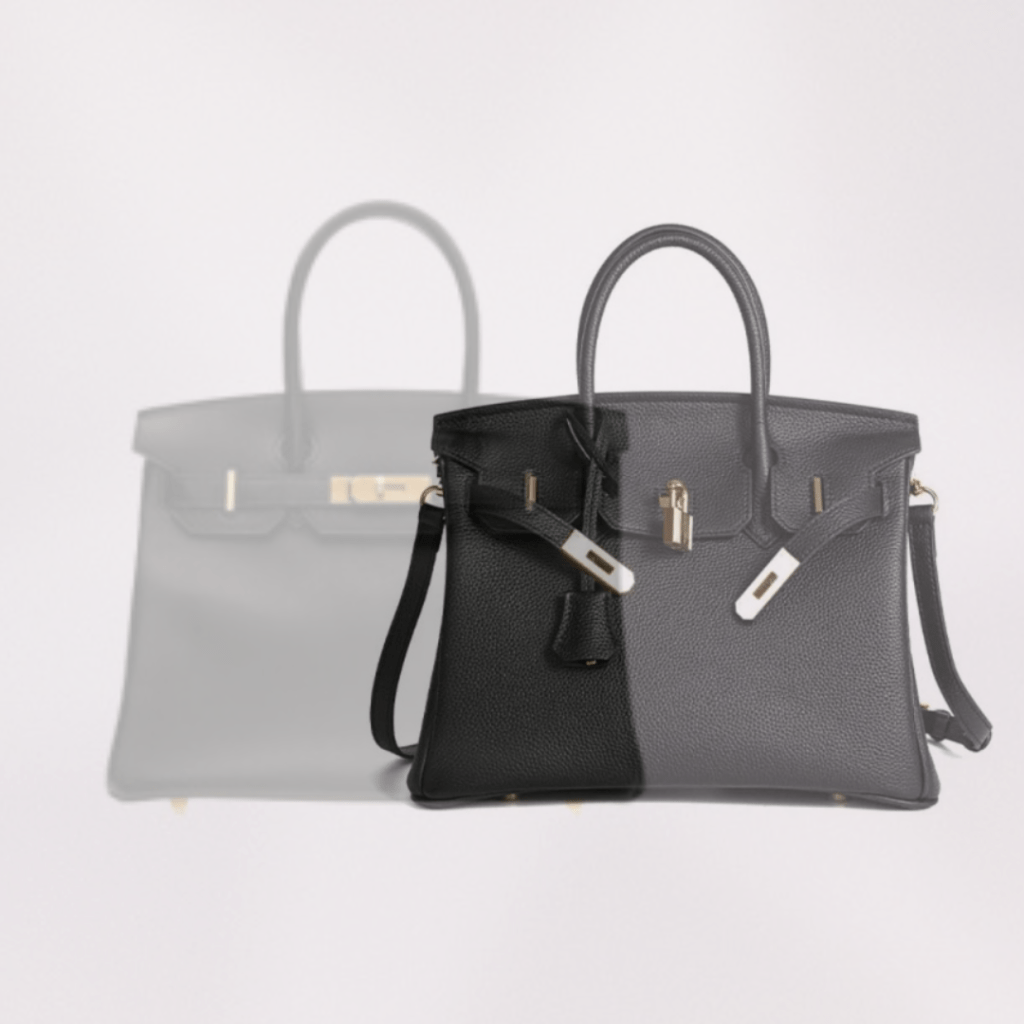
Lately, with influencers and fashionistas clamouring to get their hands on it, there has been quite some hullabaloo regarding Walmart offering, through third-party sellers, a reasonably close facsimile of the exclusive and ultra-luxurious Hermès Birkin, at a nearly 100 times lesser price point. Dubbed the “Wirkin” or “working-class Birkin”, this bag, manufactured by Kamugo and Aidrani, is making headlines for its affordability and striking resemblance to the iconic original. It has quickly been labelled a ‘dupe’; but is the Wirkin actually in the clear, legally? Most likely not.
This issue has generated widespread interest among legal professionals and purveyors of luxury fashion goods, as it raises the intriguing legal question of whether the Wirkin, in an industry long plagued by luxury brand counterfeits, is actually being marketed to deceive buyers. A 2021 report by the European Union Intellectual Property Office described the global trade in counterfeit goods as a “significant and growing threat”, with handbags being among the most frequently targeted items. However, unlike counterfeit goods, dupes occupy a legal grey area by emphasizing on creating products that bear a strong aesthetic resemblance to existing designs without directly replicating branding elements, many companies are able to avoid legal consequences and navigate around intellectual property infringement claims.
Guardians of Luxury: How Hermès Protects Its Prestige and exclusivity
While products like the Wirkin may be seen as more of a nuisance to true luxury brands that target high-net-worth and ultra-high-net-worth customers, it is noteworthy that Hermès vigilantly protects the provenance and authenticity of its products. It has, in fact, a history of fiercely protecting its intellectual property (the 2011 lawsuit against a Los Angeles-based company Thursday Friday for selling Birkin print canvas totes; the 2012 $100 million judgement against websites selling counterfeit Hermès products;[i] the 2022 trademark infringement case against MetaBirkins.[ii]) Furthermore, Courts have typically ruled in favour of Hermès, establishing a solid precedent for safeguarding the distinctive design elements of the Birkin bag. For instance, in 2022, the Italian Supreme Court ruled in favour of Hermès, essentially protecting its trademark shape from unauthorized reproductions.
Few brands, successful though they may be, have matched Hermès in establishing itself as epitomes of sheer luxury while fostering insatiable demand. Before the luxury resale market gained traction, the Birkin bag – first introduced by the French fashion house in 1984 and with a stratospheric price tag of upwards of $10,000 –was more of a fabled emblem of opulence than it was an actually attainable afoul-accessory, and it would be fair to say that it is still more or less so. Acquiring an Hermès bag involves a unique culture and a rather meticulous process. To uphold exclusivity and drive demand, the brand enforces a quota system for certain styles including the Birkin. “For the most part, you can’t walk in and buy a quota bag,” in an interview she gave to Forbes, Angelique Chamberlain, a long-time collector of Hermès. Hermès bags are produced in extremely limited quantities, and prospective buyers must collaborate with a Sales Associate to actually have the privilege of owning one.
Examining the Viability of Hermès’ hypothetical IP infringement claim
While Hermès has, so far remained tight-lipped on the ongoing controversy, are the walls of this exclusive community being breached by the Wirkin and would Hermès attempt to fortify them by setting its sight on the Wirkin producers and/or Walmart? And if it does, would its claim stand on solid legal ground?
Designs, per se, are not protectable under the U.S. Law but copyrights and trademarks are. Hermès International holds extensive trademark rights in the Birkin, including registrations with the U.S. Patent & Trademark Office for both the “BIRKIN” word mark (No. 2991927) and the bag’s distinctive source-indicating design (No. 3936105). In addition to be being registered in the U.S.A., Hermès has also registered the “BIRKIN” word mark and trade dress globally to represent its iconic handbag.
Trade dress broadly extends to “the total image of a product”, and “may include features such as size, shape, colour or colour combinations, texture, graphics, or even particular sales techniques”[iii]. In simpler terms, it is a design trademark which comes into play when its design or shape functions as a symbol of the product’s origin. Generally speaking, the more famous the trade-dress rights, the greater is the likelihood of protection.[iv] Like a trademark, a product’s trade dress is legally protectable under the Lanham Act (15 U.S.C. § 22).
The Kamugo bag features a genuine cowhide leather exterior, though the interior is synthetic, along with look-alike hardware, a cross-body strap, and mirrors the trapezoidal shape, size, and structure of the authentic Birkin, creating a striking resemblance. However, unlike counterfeits, it is not marketed as a “Birkin” and does not attempt to deceive buyers by using the “Birkin” word mark, the Hermès name, or the trademarked Hermès logo, all of which are integral to the genuine bag’s branding. But does this mean that these bags and others like it are not running afoul of the law? The answer is unequivocally no. Because they nevertheless replicate the look of the real Birkin bag which itself is protected with or without the Hermès word marks.
If Hermès were to pursue a trademark infringement claim against the makers of the Wirkin for offering it up for sale and selling it, and Walmart for facilitating such sale, the key question would be whether consumers are likely to be confused about the handbag’s origin and/or believe that Hermès is affiliated with or endorses the handbag.[v] There are several factors that would support Hermès’ case, which shall be discussed hereon.
If consumers link Walmart’s Wirkin to the iconic Birkin bag – primarily owing to the uncanny resemblance – it could weigh in favour of Hermès in a trade dress infringement claim. The question of consumer confusion between the authentic product and its dupe becomes further convoluted because it could arise post-sale. Post-sale confusion could be cited by Hermès as a credible accusation, where while the purchasing consumer might be aware of the inauthenticity of the product, the brand’s reputation is put at stake by those who see others carrying such product in a post-sale setting and confuse the same for the real deal.
While these bags are no longer listed on Walmart’s marketplace despite their booming popularity, one can still find dozens of purportedly authentic, pre-owned Hermès bags on the site ranging from $12,000 to $50,000. This could be used by Hermes to bolster its as-of-now hypothetical trademark infringement claim by asserting that the presence of potentially authentic Hermès bags on Walmart’s site increases the likelihood of consumer confusion. Hermès would have an even more compelling case if any of the Walmart’s third-party sellers deliberately infringed upon the federally registered “Birkin” trademark to market their dupes. Until recently, third-party seller Sulikehez made use of the “Birkin” and “Hermès” word marks in its dupe listing, though Walmart has since taken down the page.
The sale of a dupe product often invites accusations of intentional copying i.e. the deliberate replication of protected elements of another brand’s products to free ride off their reputation or to mislead consumers. Such accusations consider factors like design similarities, evidence of intent to copy, instances of actual consumer confusion, the likelihood of confusion, and market proximity or price alignment. In this context, Walmart and its third-party sellers could leverage the stark price disparity to argue that consumers are unlikely to confuse the two products. They could further assert that the marketing and distribution channels for authentic Birkin bags and the allegedly infringing ones are distinct, reducing the likelihood of confusion. However, Hermès could counter this argument by pointing to the thriving resale market for its coveted bags, which blurs the boundaries between previously separate distribution channels and complicates the distinction for consumers.
Regardless of the outcome of an infringement claim, Hermès would also have a dilution cause of action owing to the level of fame of its Birkin trade dress. Unlike trademark infringement, which focuses on the likelihood of confusion, a trademark dilution claim will allow Hermès to prevent unauthorized use of its famous mark, irrespective of consumer confusion, in order to protect its distinctiveness and prevent the tarnishing of the substantial goodwill it holds in connection with the mark, which is driven by the fact that the production, or rather, ‘handcrafting’ of each Birkin handbag involves extensive labour and craftsmanship alongside finest high-quality leather. This becomes even more important given the investment status Birkins enjoy, with a rate of return outperforming other more traditional forms of investment.
Conclusion
As Douglas Hand, a member of the Business Advisory Committee of the Council of Fashion Designers of America (CFDA) suggests, it would not be surprising to see Hermès take an aggressive approach considering that such overexposure potentially dilutes and devalues an extremely valuable product like the Birkin. Whether Walmart has done so innocuously or deliberately is of lesser importance considering they have either way opened themselves up for litigation from Hermès, which would likely be entitled to claim injunctions and recover damages in the form of the defendant’s profits or its own actual damages.[vi]
Image copyright credits: StyleCaster
[i] Hermès International v. John Doe, 12-CV-1623 (DLC) (SDNY).
[ii] Hermès Int’l & Hermès of Paris, Inc. v. Rothschild, 22-CV-384 (JSR) (SDNY).
[iii] Two Pesos, Inc. v. Taco Cabana, Inc., 505 U.S. 763, 765 (1992); Rose Art Industries, Inc. v. Raymond Geddes & Co., 31 F. Supp.2d 367 (D.N.J. 1998).
[iv] Abercrombie & Fitch Co. v. Hunting World, Inc., 537 F.2d 4, 9 (2d Cir. 1976); Jeffrey Milstein, Inc. v. Greger, Lawler, Roth, Inc., 58 F.3d 27, 31 (2d Cir. 1995).
[v]Two Pesos, Inc. v. Taco Cabana, Inc., 505 U.S. 763, 765 (1992).
[vi] 15 U.S.C. § 1114-1119.
 FASHION LAW
Leave a comment