
This article is co-authored by Sankalp Mirani, Final Year, B.A. LL.B. (Hons.), Maharashtra National Law University, Mumbai and Sarthak Hiremath, Final Year, B.B.A. LL.B., R.L. Law College, Belagavi.
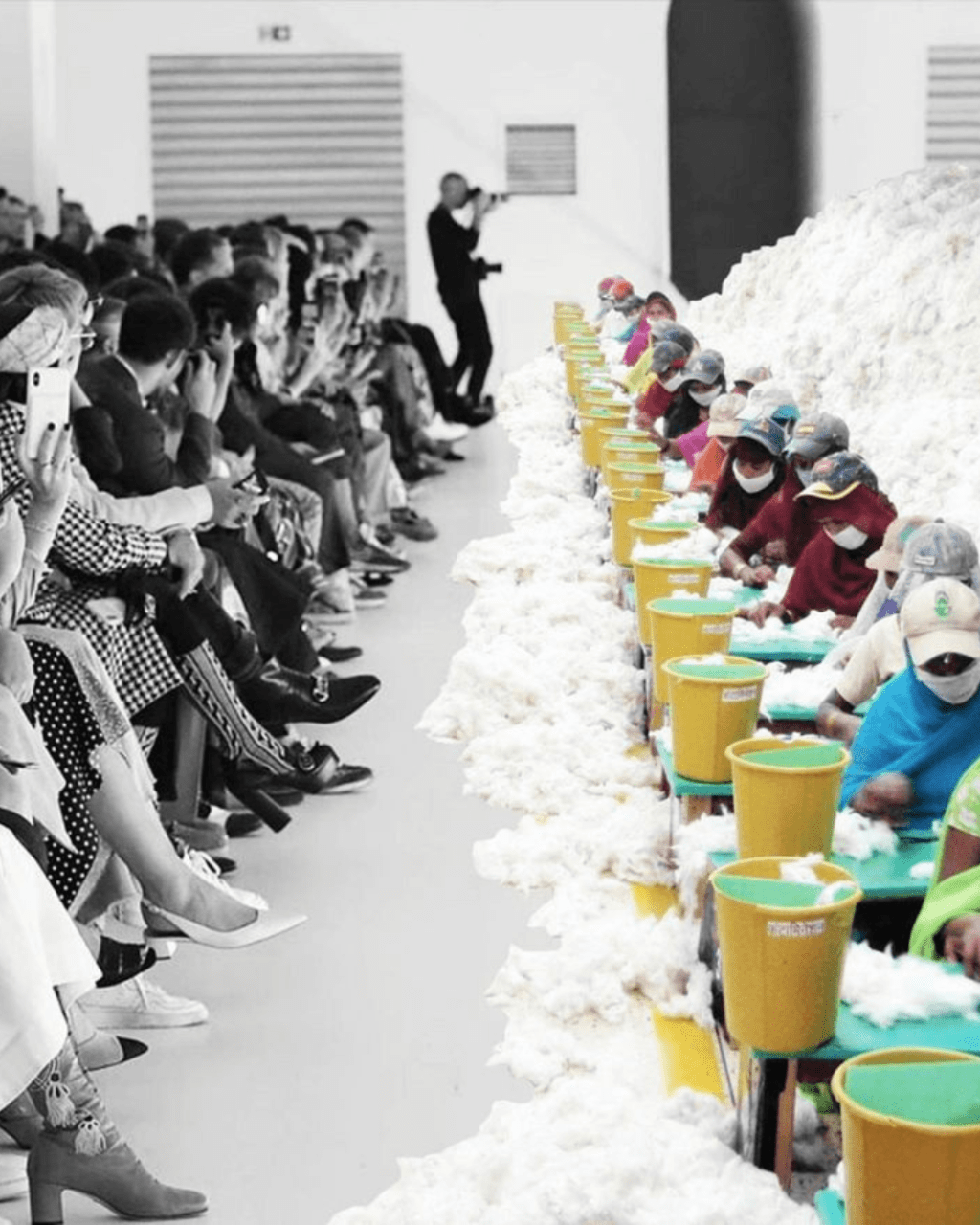
Fashion has been, for many years, a fascinating display of ingenuity and the good life. The industry is not just selling clothes; it is selling the identity, the confidence, and the feeling of being part of a group. Though, if one were to look past the glimmering facade of the runway, they would find a much less glamorous truth, which fashion has masked by hiding it in the global supply chain. The world of “take, make, and dispose,” has been mainly responsible for the rise of ultra-fast fashion, which in turn has made this creative industry one of the largest polluters of the planet.
Where does the environmental cost fit in a $5 t-shirt? The answer to that is hidden in depleted rivers, polluted water from the use of chemicals in the dying process, and heaps of discarded clothing, which cause textile graveyards in regions such as Ghana or the Atacama Desert in Chile. This is not just waste; it is a murder of the environment which has been ignored for far too long. However, the fashion industry is finally being held accountable, and this change is led by Europe, who came up with a bold and binding plan. It certainly is not about doing a few tweaks or voluntarily greenwashing ones’ image, it is about fundamentally changing the whole industry, a daring attempt to confront a long history of environmental neglect and direct fashion to a future where style and sustainability go hand in hand.
The Heart of the Revolution: A New Era of Responsibility
The disruptive regulation at the core of all this turmoil is a policy called Extended Producer Responsibility (EPR). It may seem like a mere technical term, but the notion of EPR has a huge impact on people. Just radically it changes the idea of which party is responsible. For the first time, European Union fashion brands, retailers, and e-commerce companies will be financially and operationally responsible for the entire lifecycle of their products, especially what will be done with them after the consumers, i.e. us, have used them.
It is a local application of the “polluter pays” principle where, in your case, the polluter is your closet. For a long time, the cost of gathering and handling textile waste has been up to local municipalities and, thus, to the taxpayers. In fact, we have been paying for the mess that a multi-trillion-dollar industry has left behind. According to the new regulations, companies will have to pay the fees which will be used to finance the plans that will collect, sort, reuse and recycle their products.
One of the remarkable features of this structure is the clever utilization of “eco-modulation”. The fees will not be a single-size-fits-all kind of punishment. The fees will be adjusted dynamically according to the environmental credentials of a product. A manufacturer that produces a durable jacket made of recycled materials, using clean dyes and making it easy to repair, will get lower fees as a reward. On the other hand, a company producing a product-line of flimsy, trend-of-the-week garments made for the purpose of falling apart after a few washes will only be charged a higher financial penalty. As a result, there is an utterly strong incentive here to switch from a throwaway business model to circular design that is thoughtful right from the first sketch.
Beyond the Linear Treadmill: Weaving a Circular Future
This EPR is the EU’s powerful engine for the much broader and ambitious Circular Economy Action Plan, a detailed plan for a more sustainable and resilient society. The plan aims at the wasteful linear model which has ruled our economy for hundreds of years. The numbers tell the harsh truth. 87% of fiber input for clothing, roughly, ends up in landfills or is incinerated, which is a tremendous loss of material and value.
To do that, the EU is putting all the pieces in place for a suitable network.
A New Language of Transparency: The Digital Product Passport
The EU is not only picturing a circular system but is also planning to hold companies accountable for their promises by the introduction of a very revolutionary tool, mandated under the Regulation on Ecodesign for Sustainable Products (ESPR, 2024): the Digital Product Passport (DPP). It is expected to start the operation in the next few years, the DPP will be like a digital ID card for each and every textile product sold in the EU.
If you scan with your smartphone a simple QR code on the label of a garment, you will be able to access in-depth information about its journey. This passport will explain the product’s components; the origin of the fibers will tell where the fibers were grown and where the product was made. In addition, it will show the carbon, water footprints of the product and most importantly it will have clear, unambiguous, care instructions for the customer, guidance for repair as well as the proper recycling method at the end of the product life.
It’s hard to emphasize enough the importance of the game changer that the DPP is. Over time, businesses will find it easier to send their sustainability reports to the EPR schemes through this system. The existence of such information is also very helpful to consumers who are willing to pay attention and this is the essence of the transparency era. It goes beyond finding out who the suppliers are; it gives us the power to make enormously informed decisions that match our principles. This action is a direct response to a groundswell of consumer demand, with research continuously revealing that a clear majority of shoppers require brands to be more transparent and provide evidence rather than make green claims.
Navigating the Double-Edged Sword of Intellectual Property
While this regulatory change is a powerful driver of positive change, the shift toward a circular fashion economy still poses complex challenges, especially concerning intellectual property (IP). The regulations relating to trademarks and design rights create an intricate paradox. On one hand, robust IP protection can act as a barrier to the rapid copying that is characteristic of fast fashion, thereby, in theory, a designer can be more willing to create than one of short-lived, lower-quality, of durable creations, knowing that will be harder to be copied.
Conversely, these laws may significantly hinder the implementation of circularity measures. The features of repair, refurbishment, and upcycling, in general, are the aspects that border on changing or reselling the branded goods. An independent artisan who wants to expertly repair a luxury handbag or a creative designer who transforms old branded jeans into a new, unique jacket could potentially face legal challenges for trademark infringement. It will be a matter of finding a new balance that still awards creativity and innovation without limiting the small and vital market for secondhand goods and repair services, which many legal experts and sustainability advocates, such as those at the Ellen MacArthur Foundation, are currently discussing.
A Shared Thread: The Path Forward
In the end, legislation can only provide the groundwork. A fashion industry that is truly sustainable goes beyond this and needs a cultural paradigm shift. Whether or not these new European laws will be successful depends on the shared sense of responsibility, which not only brands but also consumers and policymakers must embrace.
Brands need to go beyond conforming to the law and integrating transparency and ethics not just as the principle but the very core of their business. They must understand that in the 21st century, the trust of consumers is closely connected with the company’s environmental and social responsibility. Consumers are also provided with the tools to make better demands. A consumer who decides to buy more expensive products of better quality, more durable, made with good environmental practices, and follows the “buy less, but buy better” mentality, sends a message to the market that consumers will not tolerate waste as a business model anymore. However, the ambitious dream of this law has many obstacles in reality, especially in the enforcement part. It is an enormous logistical challenge to keep track of compliance through long and fragmented global supply chains. In addition, making sure that foreign products are meeting the same strict standards will be a very difficult job, which might create some loopholes that could weaken the overall legislative impact. The success of EU’s green agenda depends not only on how ambitious it is, but also on its ability to establish a strong and real global system for verification and enforcement.
EU’s landmark legislation is a courageous and necessary step in dealing with one of the major environmental challenges of the period. With this, the corporate accountability level is raised worldwide and the way to an industry that is innovative, sustainable, and not harming nature becomes obvious. There will be problems and adjustments on the road, but the destination is a world in which the Earth’s resources are not the sacrifice for the clothes we wear.
 FASHION LAW
Leave a comment