
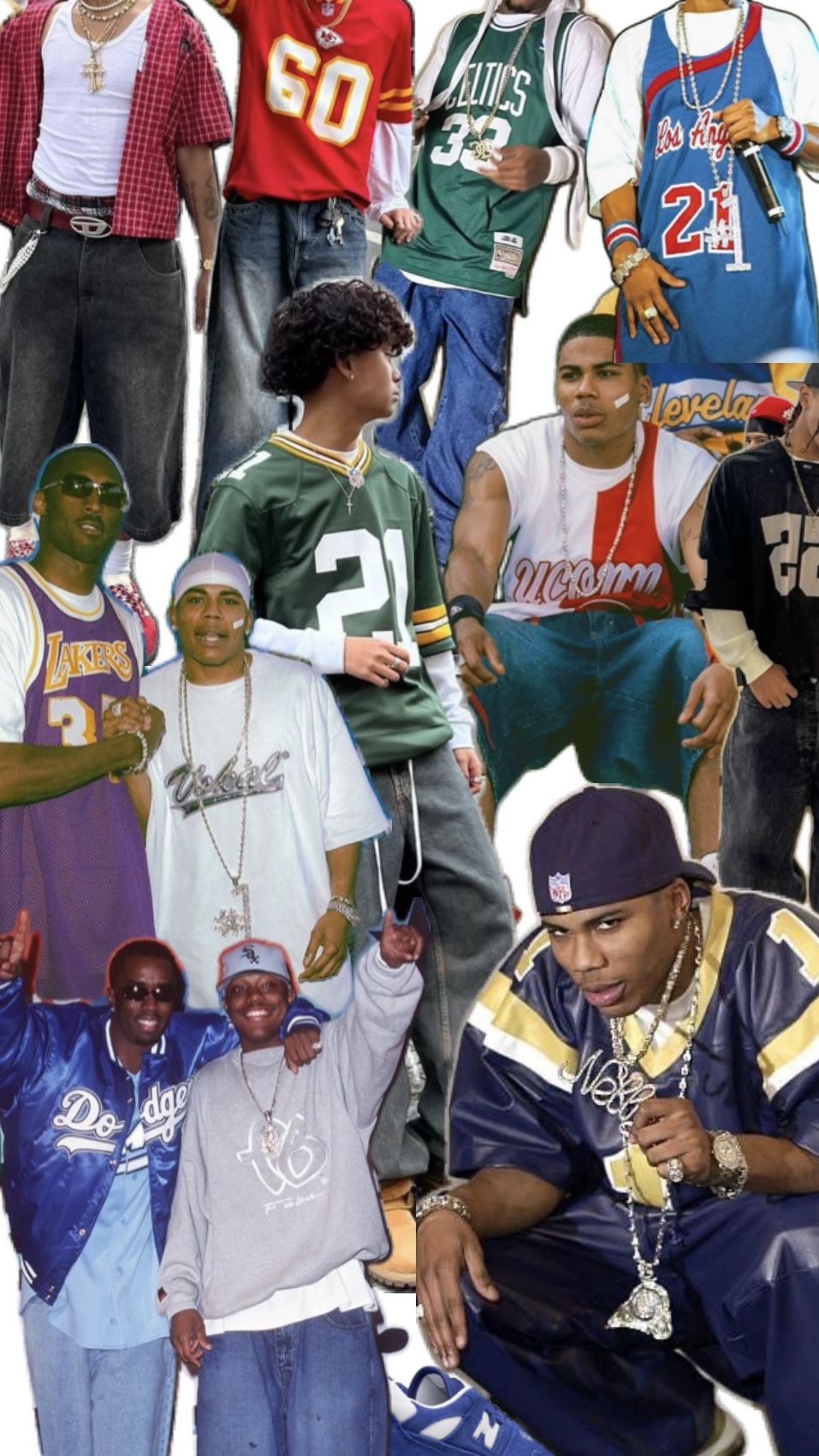
The origins of rap and hip-hop culture in the 1970s South Bronx produced a distinctive streetwear style that quickly influenced mainstream fashion. Pioneering artists wore thrift-store and athletic items, oversized track jackets, Adidas sneakers, bucket hats and chunky gold jewelry, as bold statements. Early icons like Run-DMC in Adidas tracksuits and New York DJs fused sportswear (tracksuits, Timberlands) and Afrocentric elements (bold colors, kufi hats), defining a look of resourcefulness and cultural pride. This wasn’t haute couture but a “raw, real, and relatable” aesthetic born of marginal communities.
By the 1990s, hip-hop fashion became more visible on the streets and in media. Baggy jeans, extra-large hoodies and logo-heavy tees were ubiquitous in rap videos and urban neighborhoods. Streetwear brands founded by or associated with hip-hop (Tommy Hilfiger, FUBU, Phat Farm, Sean John) capitalized on this trend. Accessories like snapbacks, Timberland boots, and nameplate chains were added for swagger. In essence, early hip-hop styles, borrowed from sportswear and embellished by the artists’ attitudes, both reflected and reshaped youth identity and set the stage for later trends.
Key Aesthetic Shifts: Streetwear Meets Luxury
In the 2000s and 2010s, hip-hop further transformed fashion by blurring the line between streetwear and high fashion. The era of “bling” gave way to a street-luxury crossover: artists paired gym-wear staples (baggy jeans, hoodies, tracksuits) with designer labels. Luxury houses began to embrace rap culture, leading to formal collaborations. As one account notes, rap icons and designers “didn’t just merge two worlds; they redefined them,” proving that innovation lies at the intersection of urban culture and couture. For example, Kanye West’s Adidas-backed Yeezy line epitomized this fusion, seamlessly blending streetwear with high-fashion sensibilities. At the same time, designers like Dapper Dan and later Virgil Abloh infused runway fashion with hip-hop’s DNA, Dapper Dan by “blackenizing” Gucci and LV monograms for Harlem youth, and Abloh’s Off-White doing streetwise deconstruction at Louis Vuitton. These shifts turned what was once considered niche “urban fashion” into a dominant trend.
Rapper-Led Fashion Brands
As hip-hop stars gained wealth and influence, many launched their own labels. Sean “Diddy” Combs founded Sean John in 1998, immediately becoming a hit by “fusing urban style with luxury”, think velour tracksuits, puffy vests and gold accessories on the runway. Drizzy Drake’s October’s Very Own (OVO) brand (launched 2011) grew from tour merch into a fashion powerhouse, known for its exclusive black-and-gold streetwear and partnerships with Roots and Jordan Brand. Likewise, Kanye West’s Yeezy (with Adidas) reshaped sneaker and apparel design: Adidas even hailed the Adidas–Yeezy deal as “the most significant partnership between a non-athlete and a sports brand”. Other rappers joined in: Jay-Z’s Rocawear (founded 1999) and Nelly’s Vokal mirrored this street-meets-luxury approach. More recently, Travis Scott’s Cactus Jack imprint has produced high-profile collabs (e.g. Nike sneakers) and even a joint Dior Men’s collection. Even artists who are also designers, like Pharrell Williams (BBC/Ice Cream), operate at this intersection, blending hip-hop aesthetics with luxury branding. Together, these rapper-led brands turn each artist’s identity into a fashion label, amplifying hip-hop’s role as a trendsetter.
Fashion as Identity and Resistance in Hip-Hop
Fashion in rap has always been more than vanity, it’s a form of self-expression and social commentary. Early hip-hop emerged from marginalized Bronx communities as “a form of self-expression and empowerment”. Wearing designer logos or oversized workwear was a deliberate challenge to social norms. As one style guide notes, ’90s hip-hop “fashion was a form of resistance”, baggy clothes and bold chains “pushed back against Eurocentric beauty standards and restrictive norms. It was pride. It was protection. It was political.”. Scholars similarly point out that hip-hop’s aesthetic carries a “history born of struggle, creative resistance, and contestation”. The work of Dapper Dan in the 1980s exemplifies this: by reworking Gucci and Louis Vuitton patterns into custom street garments, he enabled Black youth to claim the status symbols of wealth and “created an identity for a group otherwise left out of luxury”. In short, rap fashion has long signaled community identity and defiance. Sporting a logo-laden tracksuit or a symbolic color could simultaneously say “this is who I am” and “I belong in the world of fashion, too.”
Collaborations: Rappers and High Fashion Houses
In the last two decades, many collaborations between hip-hop figures and luxury brands have grabbed headlines. Pharrell Williams, part of the original Neptunes hip-hop duo, has a long LVMH history. He ran Billionaire Boys Club/Ice Cream in the 2000s and collaborated on Louis Vuitton accessories (his “Millionaire” sunglasses, 2004). In 2023 he even became Louis Vuitton Men’s Creative Director, the French house crediting him as a “visionary” after earlier LV partnerships. Similarly, in 2013 Kanye West shocked fans by signing a footwear partnership with Adidas (after leaving Nike). His Adidas-Yeezy releases (Boost sneakers, street-ready apparel) were phenomenally successful, leading Adidas to extend the deal through 2026. Newer examples include Travis Scott’s work with Dior, the Dior Men S/S 2022 show was the first full collection “created with a musician” (Scott), and ongoing Nike collaborations with rap artists for signature sneaker lines. These partnerships have both driven profits and validated hip-hop’s design influence: high fashion now routinely taps rap stars’ creativity (e.g. Gucci’s collaboration with Dapper Dan’s Harlem atelier, Louis Vuitton’s collabs with Pharrell) to stay culturally relevant.
Influence on Youth, Global Streetwear and Marketing
Today hip-hop style is truly global and youth-driven. As one cultural analyst observes, “hip hop culture is global…a global phenomenon… driven by unique values, norms, behaviors”. In practice, a rapper in Atlanta can spark a clothing trend in Seoul or Lagos overnight. Streetwear, once niche, is now the language of youth fashion, largely shaped by hip-hop icons. Research shows that brands like Supreme, Off-White and Yeezy (all steeped in rap culture) have become “powerful influences on youth identity and social status”. Modern marketing fully exploits this: limited-edition “drop” releases (collabs between rappers and shoe or clothing brands) create frenzy among Gen Z, and hip-hop stars are omnipresent on Instagram and TikTok, making their style instantly viral. One 2024 study notes that social media and e-commerce have amplified hip-hop’s reach, with young consumers worldwide participating in rap-driven streetwear cycles. In sum, hip-hop fashion now dictates trends from Tokyo to Toronto, global youth look to rap’s streetwise aesthetics, and marketers routinely leverage the culture (endorsements, videos, “hype” campaigns) to connect with new generations.
References:
- ‘50 Years of Hip Hop: A Fashion Revolution’ University of Fashion Blog
https://www.universityoffashion.com/blog/50-years-of-hip-hop-a-fashion-revolution/. - ‘90s Hip Hop Fashion Trends That Still Influence Style Today’ AliDrop Blog
https://www.alidrop.co/blogs/hip-hop-90s-fashion-trends. - ‘The Rise of Hip-Hop Fashion: From the Streets to the Runway’ Timeless Fashion Hub
https://timelessfashionhub.com/modern-fashion/20th-century/the-rise-of-hip-hop-fashion-from-the-streets-to-the-runway/. - ‘26 Style Trends That Were Popularized by Hip-hop’ Stacker
https://stacker.com/stories/music/26-style-trends-were-popularized-hip-hop. - ‘Counterfeits and the Appropriation of Streetwear: A Case Study of Dapper Dan’ The Fabric of Crime (23 April 2021)
https://fabricofcrime.ca/2021/04/23/counterfeits-and-the-appropriation-of-streetwear/. - ‘October’s Very Own Clothing Label OVO’ Story Cape Town
https://www.story.capetown/blogs/news/october-s-very-own-clothing-label-ovo. - ‘The Rise and Fall of the Adidas-Yeezy Partnership: A Timeline of Success, Controversy, and Collapse’ The Learning Hip Hop
https://thelearning.hiphop/p/the-rise-and-fall-of-the-adidas-yeezy. - ‘Travis Scott Celebrates His Dior Collab in Slick Style’ Vogue
https://www.vogue.com/article/travis-scott-dior-cactus-jack-collaboration-paris. - Pharrell Williams, ‘Pharrell Williams Brings a Long History of Fashion Collaborations to His New Role at Louis Vuitton’ Andscape
https://andscape.com/features/pharrell-williams-brings-a-long-history-of-fashion-collaborations-to-his-new-role-at-louis-vuitton/. - ‘Commercialization of Hip-Hop Culture and the Evolution of Youth Consumption Patterns from Symbols of Rebellion to Fashion Trends’ Art and Society
https://www.paradigmpress.org/as/article/view/1362. - SAGE Publications, ‘Chapter 3’
https://us.sagepub.com/sites/default/files/upm-binaries/45712_Chapter_3.pdf.
 FASHION LAW
Leave a comment