
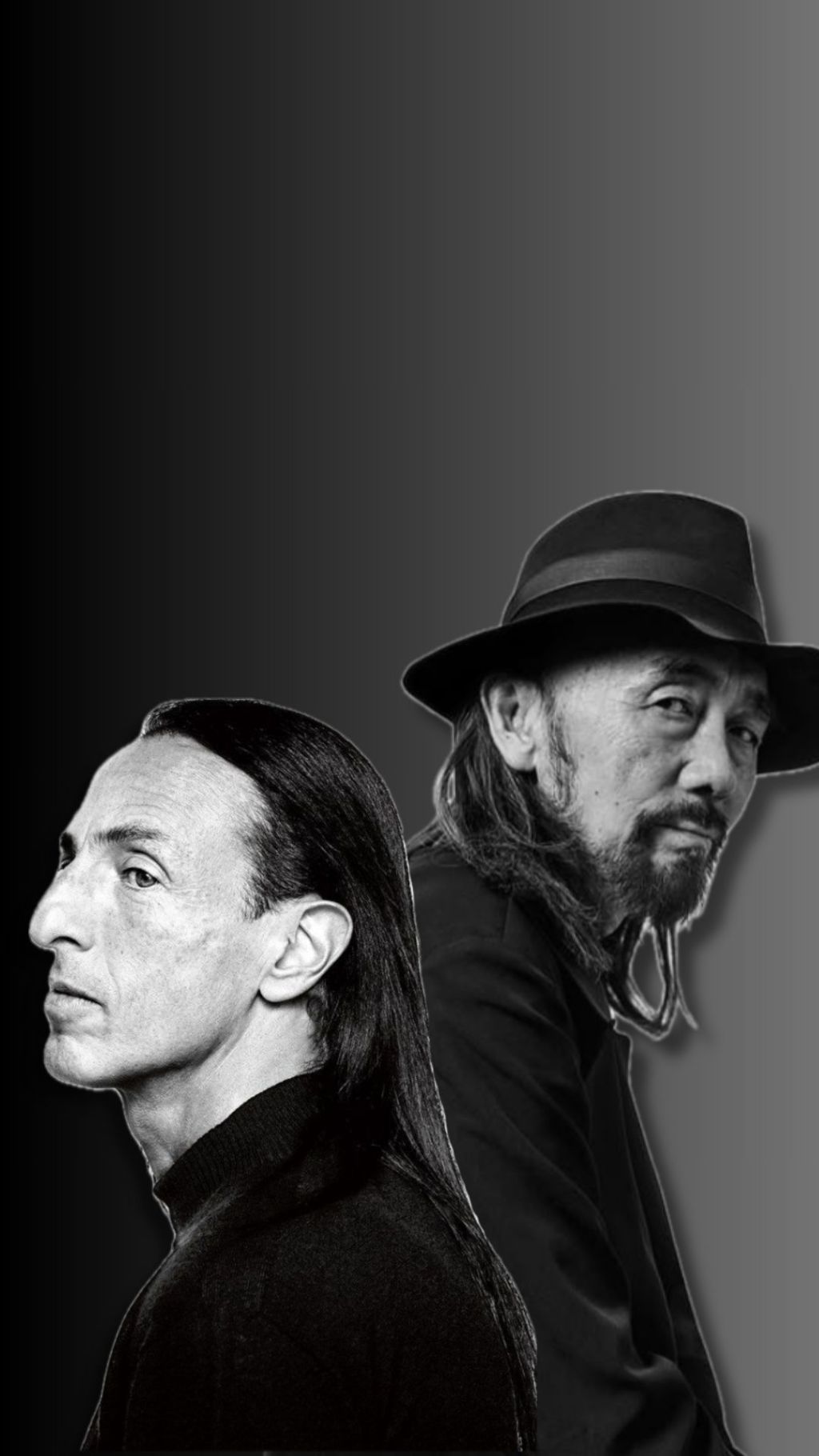
Issued by the Editorial Board, Fashion Law IP Blog.
The trajectories of Yohji Yamamoto and Rick Owens offer a compelling counter-narrative to fashion’s reliance on ostentatious branding. Emerging from unconventional origins, Yamamoto delivering a seismic Paris debut in 1981 and Owens launching in Los Angeles in 1994, both designers anchored their empires in a rigorous rejection of commercial norms. For scholars of design and brand jurisprudence, their success exemplifies the profound power of “trade dress”, securing brand recognition not through a printed trademark, but through the intrinsic architecture of the product itself.
Rather than relying on monograms, both engineered unmistakable sartorial vocabularies that function as proprietary signatures. Yamamoto disrupted the establishment with dramatic asymmetry, intentional deconstruction, and a profound commitment to black, while Owens sculpted a visual identity rooted in brutalist, post-apocalyptic glamour. In the absence of a traditional logo, their garments rely entirely on silhouette and proportion to establish secondary meaning. The consumer recognizes the creator by the garment’s structural DNA, transforming design philosophy into a legally fascinating, instantly recognizable identity.
This refusal to conform extends directly into a calculated anti-marketing strategy. In a fashion industry obsessed with algorithmic visibility and constant digital engagement, both designers build exclusivity by remaining intentionally mysterious. Instead of relying on heavy digital self-promotion or traditional advertising campaigns, they let theatrical runway shows and organic word-of-mouth dictate their narrative. By starving the market of conventional corporate communication, Yamamoto and Owens prove that a strategic silence can actually amplify a brand’s intrigue and cultural influence.
This immersive philosophy is meticulously translated into their retail environments, which function as curatorial installations rather than traditional points of sale. Whether through Yamamoto’s deconstructivist, monochromatic flagships or Owens’s stark, sculpted boutiques, these physical spaces operate as extensions of their intellectual property. They envelop the consumer in a holistic aesthetic jurisdiction that reinforces the brand narrative without overt signage.
Crucially, their expansion into diffusion labels demonstrates a sophisticated approach to brand architecture. Ventures like Yamamoto’s pioneering Y-3 collaboration with Adidas and Owens’s DRKSHDW democratize their visions without diluting core brand equity. These sub-labels adhere strictly to the foundational ethos of the mainline collections, ensuring the brand’s visual trademark remains uncompromised across varied price points.
Ultimately, this steadfast dedication to a unified creative vision has cultivated consumer devotion bordering on the sociological, from Yamamoto’s veneration in the archive fashion community to Owens’s cult-like following. For the contemporary student, their methodologies underscore the true efficacy of “quiet luxury” and unregistered design rights. By framing status around the esoteric recognition of craftsmanship and silhouette rather than conspicuous logos, Yamamoto and Owens prove that a rigorously defended creative identity is the most enduring asset a brand can possess.
Brand Origins & Founder Narratives
The genesis of an enduring fashion house often relies on a founder narrative that functions much like a foundational legal doctrine. For Yohji Yamamoto and Rick Owens, ascensions from unconventional, outsider backgrounds provided the ideological bedrock necessary to sustain cultural relevance without traditional branding. Yamamoto, famously pivoting from formal legal studies in Tokyo to establish his label in the 1970s, and Owens, a self-taught pattern-maker navigating the legal gray areas of garment replication in 1990s Los Angeles, both underscore a vital lesson in brand equity, profound structural innovation often originates at the margins, far removed from orthodox design centers.
Yamamoto’s 1981 European debut was less a commercial launch and more a deliberate subversion of the era’s opulent sartorial statutes. Driven by a desire to shield the female form from external objectification, he engineered a protective vocabulary of voluminous, asymmetrical silhouettes and unfinished, stark black garments. By cultivating the archetype of the stoic artisan who steadfastly ignores the frantic hype-cycles of modern commerce, Yamamoto positioned his intellectual property as an enduring safe haven from transient trends.
Owens’s trajectory is similarly rooted in a conscious rejection of mainstream conformity, transmuting a restrictive Californian upbringing into an austere, deeply personal aesthetic universe. After gaining grassroots traction and securing critical industry sponsorship, he relocated to Paris to establish Owenscorp alongside his intellectual collaborator, Michèle Lamy. Approaching fashion with the spatial considerations of a sculptor, Owens meticulously eradicated commercial clichés and logos from his vernacular, instead entangling his brand identity with his own ascetic persona and the media-bestowed “Lord of Darkness” moniker.
For the contemporary student of fashion or brand law, the enduring power of these labels lies in the seamless integration of personal mythology and commercial output. Yamamoto’s evolution from disillusioned law student to avant-garde protector, and Owens’s transformation from subversive pattern-maker to architectural visionary, are irrevocably encoded into their corporate identities. By inextricably linking their authentic, uncompromising narratives to their design philosophies, they have constructed brand architectures that transcend the garments themselves, remaining virtually immune to the fluctuating jurisdictions of fleeting trends.
Signature Visual Language
At the core of both brands lies a rigorously defended visual language that functions as an unregistered trademark, or “trade dress,” entirely superseding the need for conventional logos. This is immediately evident in their ascetic color palettes. Yamamoto notoriously anchored his label in a profound commitment to black, a reaction against the visual fatigue of contemporary fashion, establishing a monochromatic signature that is now inextricably linked to his corporate identity. Owens similarly restricts his spectrum to what have been termed “non-colors”, dust, mud, grey, and ivory, utilizing shade and shadow as a proprietary visual identifier rather than relying on explicit branding.
Beyond color, their silhouettes and material choices operate as structural signatures. Yamamoto engineers voluminous, deliberately unbalanced garments, utilizing robust Japanese fabrics and intentionally undone hems to create movable architecture that protects the wearer. Owens, in contrast, constructs elongated, architectonic forms. His mastery of supple leathers and heavy jerseys results in drop-crotch trousers and sculptural jackets that drape with a brutalist, utilitarian elegance. For both designers, the physical construction, whether Yamamoto’s calculated deconstruction or Owens’s deliberate incompleteness, serves as the identifying intellectual property, making each garment recognizable by its structural DNA rather than a printed emblem.
This uncompromising aesthetic extends into their physical retail spaces and broader commercial strategies. Both designers reject traditional marketing frameworks, relying instead on spatial curation and intentional scarcity. Yamamoto’s museum-like, deconstructivist boutiques and Owens’s stark retail environments, such as his London flagship featuring robotically-milled foam walls inspired by operatic sets, act as immersive spatial trademarks. By eschewing overt advertising and personal visibility, they cultivate an aura of authentic exclusivity, proving that a refusal to engage in traditional marketing can paradoxically heighten brand equity and consumer intrigue.
Ultimately, this rigorous adherence to a distinct visual language cultivates a deeply entrenched consumer base, transforming traditional brand loyalty into fervent aesthetic tribalism. Yamamoto is revered within the archive fashion community for his avant-garde minimalism, while Owens commands a devoted faction of self-described misfits who view his work as a cultural movement. Both operate within the highest echelons of luxury pricing, justified by uncompromising craftsmanship and longevity rather than conspicuous branding. For the modern student of brand architecture, their success illustrates that true status and commercial endurance can be achieved when a brand’s visual identity is so potent, the silhouette itself becomes the ultimate signal of belonging.
TRADE DRESS, CULT STATUS, AND THE ARCHITECTURE OF QUIET LUXURY
Just as their garments operate as unregistered design rights, the retail environments of Yohji Yamamoto and Rick Owens function as immersive exercises in spatial jurisprudence. Stripped of conventional, flashy signage, their boutiques operate as architectural extensions of their core brand narratives. Yamamoto’s flagships, characterized by deconstructivist, monochromatic film noir aesthetics, and Owens’s brutalist spaces, such as his London boutique featuring robotically carved foam walls inspired by operatic sets, ensure that consumers instantly recognize the brand’s signature trade dress the moment they cross the threshold. The physical space itself dictates the brand story, enveloping the consumer in a highly curated aesthetic jurisdiction without relying on a single printed logo to signify luxury.
In a commercial landscape dominated by algorithmic saturation, both designers strategically deploy scarcity and theatricality in lieu of traditional marketing. Rejecting logo-centric campaigns and conventional public relations, they rely on idea-driven runway presentations, Yamamoto’s poetic explorations of fabric movement and Owens’s cult-status performative shows, to generate organic, word-of-mouth mystique. Even highly commercial diffusion ventures, such as Yamamoto’s pioneering Y-3 partnership with Adidas and Owens’s DRKSHDW label, prioritize structural design synergy over garish co-branding. This refusal to over-expose their intellectual property cultivates an exclusive, insider ecosystem where cultural relevance is driven by archival rediscoveries and fervent street-style communities rather than corporate social media feeds.
This uncompromising dedication to a singular vision has birthed highly insular, cult-like consumer demographics, from the “Yohji-ssance” archive collectors to the fiercely devoted “Rick Army.” For these consumers, status signaling is entirely coded. Because the garments lack overt branding, recognition operates as a visual handshake among the initiated; the uninitiated outsider sees merely a black coat, while the insider instantly perceives the intellectual underpinnings of an asymmetrical drape or a drop-shoulder cut. This dynamic fundamentally disrupts the traditional paradigm of luxury consumption. Buyers are not purchasing a branded badge for broad, external validation; they are securing membership within an exclusive avant-garde tribe, where status is conferred purely through the esoteric discernment of structural design.
Ultimately, the economic endurance of these logo-less empires rests on a foundation of extreme product longevity and uncompromising craftsmanship. By consciously rejecting the accelerated obsolescence of the fast-fashion cycle, Yamamoto and Owens engineer “lifetime” pieces that retain immense archival and secondary-market value. For contemporary students of design and brand architecture, their business models offer a profound precedent, a meticulously crafted structural identity, where the creator’s philosophy is irrevocably woven into every seam, is a far more resilient corporate asset than a printed trademark. They prove that true luxury is quiet, demanding that the garment itself carry the weight of the brand’s legacy without ever needing to shout its name.
Conclusion
Yohji Yamamoto and Rick Owens flipped the branding playbook. In worlds dominated by tags and trademarks, they built brands that are recognized by silhouette, substance, and spirit instead of a badge. Their success shows that a logo is optional when your clothing conveys a distinct message and worldview.
These designers ask: What if the garment itself is the brand? By making each piece a direct reflection of their vision, and never letting a logo speak for them, Yamamoto and Owens have become legends whose signatures are woven, not printed. In the end, it’s a powerful paradox. By daring not to brand themselves in the usual way, they created a brand no one can miss.
References:
- Tungate M, Fashion Brands: Branding Style from Armani to Zara (3rd edn, Kogan Page 2012).
- Kapferer JN and Bastien V, The Luxury Strategy: Break the Rules of Marketing to Build Luxury Brands (2nd edn, Kogan Page 2012).
- Frankel S, Yohji Yamamoto (Thames & Hudson 2010).
- Owens R, Rick Owens (Rizzoli International Publications 2011).
- English B, Japanese Fashion Designers (Bloomsbury Academic 2011).
- ‘Rick Owens: The World According to Rick’ The Business of Fashion (2021).
- ‘Yohji Yamamoto Interview: Clothing Has No Life Until It Is Worn’ AnOther Magazine (2019).
- The Business of Fashion, ‘Rick Owens’ https://www.businessoffashion.com/people/rick-owens/
- The Business of Fashion, ‘Yohji Yamamoto’ https://www.businessoffashion.com/people/yohji-yamamoto/
- ‘Yohji Yamamoto Interview: Clothing Has No Life Until It Is Worn’ AnOther Magazine (2019).
- ‘Rick Owens: The World According to Rick’ The Business of Fashion (2021).
- Menkes S, ‘The Poetry of Black: Yohji Yamamoto’s Enduring Influence’ Vogue (Paris, 1 October 2020).
- Fury A, ‘Rick Owens and the Art of Building a Fashion Universe’ Financial Times (London, 18 June 2022).
- Mower S, ‘Yohji Yamamoto Spring 2024 Ready-to-Wear’ Vogue Runway (29 September 2023).
- Mower S, ‘Rick Owens Fall 2024 Menswear’ Vogue Runway (18 January 2024).
- Yohji Yamamoto Official Website.
- Rick Owens Official Website.


Leave a Reply