
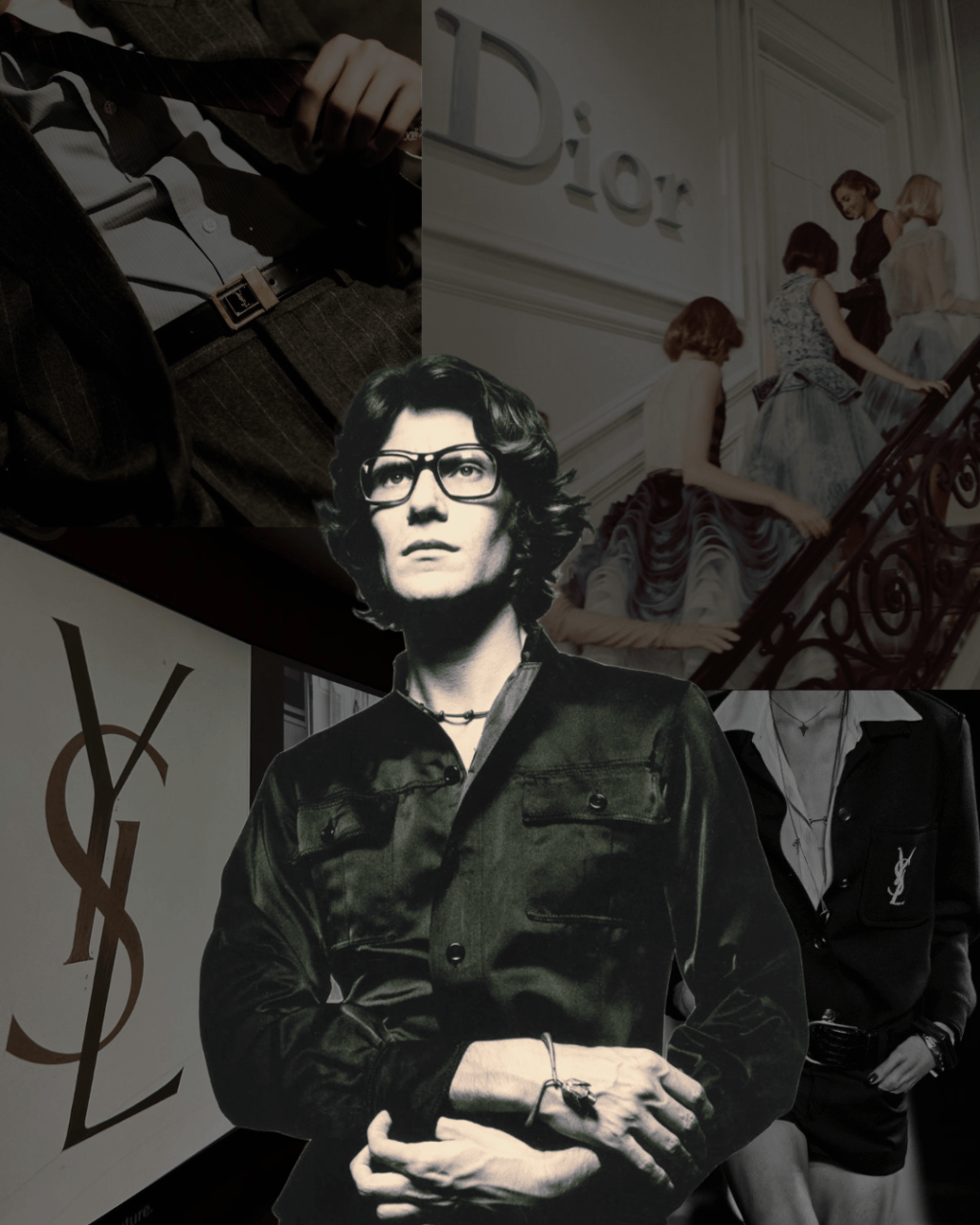
Issued by the Editorial Board, Fashion Law IP Blog.
The history of modern fashion cannot be discussed without acknowledging the profound influence of Yves Saint Laurent. Often celebrated as one of the twentieth century’s greatest couturiers, Saint Laurent transformed fashion from a means of adornment into a medium of cultural expression, artistic experimentation, and social commentary. His designs challenged conventions surrounding gender, luxury, and accessibility, while his business decisions reshaped the structure of the fashion industry itself.
Today, Saint Laurent remains one of the world’s most recognizable luxury houses. While the brand is often associated with iconic creations such as Le Smoking tuxedo or the famous YSL monogram, its legacy extends far beyond individual garments. It represents the evolution of haute couture, the rise of luxury ready-to-wear, and the ability of fashion to reflect broader societal change. Understanding the history of Yves Saint Laurent is therefore not merely an exploration of a fashion house but an examination of how one designer fundamentally altered the trajectory of modern fashion.
The Making of a Fashion Prodigy
Yves Henri Donat Mathieu-Saint-Laurent was born on 1 August 1936 in Oran, Algeria, then under French colonial administration. From an early age, he displayed an unusual fascination with fashion, frequently sketching garments and creating paper dolls instead of engaging in conventional childhood activities. His artistic inclination was encouraged by his mother, whose appreciation for couture exposed him to the elegance of Parisian fashion long before he entered the industry.
At the age of seventeen, Saint Laurent moved to Paris to study at the Chambre Syndicale de la Haute Couture, the institution responsible for training many of France’s leading couturiers. His exceptional sketches soon attracted the attention of Michel de Brunhoff, editor of French Vogue. Recognizing his remarkable talent, Brunhoff introduced the young designer to Christian Dior, whose fashion house represented the pinnacle of post-war haute couture.
Dior quickly recognised Saint Laurent’s extraordinary ability to balance creativity with technical precision and employed him as an assistant. This opportunity placed the young designer at the centre of the world’s most influential couture house and laid the foundation for his future career.
The Dior Years
The unexpected death of Christian Dior in 1957 created uncertainty within the fashion industry. Rather than appointing an experienced successor, the House of Dior selected the twenty-one-year-old Yves Saint Laurent as its Artistic Director. The decision was unprecedented, yet Saint Laurent quickly demonstrated his capability.
His debut collection, known as the Trapeze Line, departed from the highly structured silhouettes associated with Dior’s famous “New Look.” Instead, it introduced softer lines, greater freedom of movement, and a youthful elegance that resonated with contemporary audiences. The collection received widespread acclaim and established Saint Laurent as one of fashion’s brightest talents.
However, his tenure at Dior proved short-lived. In 1960, Saint Laurent was conscripted into the French Army during the Algerian War. The experience severely affected his mental health, leading to his hospitalization. During his absence, Dior replaced him with Marc Bohan. Although this marked the end of his association with Dior, it also became the catalyst for establishing one of fashion’s most influential independent houses.
The Birth of the House of Yves Saint Laurent
In 1961, with the support of his lifelong business partner Pierre Bergé, Yves Saint Laurent established his own fashion house in Paris. While Saint Laurent provided the creative vision, Bergé developed the commercial strategy that enabled the brand to flourish internationally. Their partnership remains one of the most significant collaborations in fashion history, demonstrating the importance of balancing artistic excellence with business acumen.
Unlike many couture houses that focused exclusively on affluent clientele, Saint Laurent envisioned fashion as a reflection of contemporary life. His collections embraced women who were increasingly entering professional spaces, travelling independently, and redefining traditional gender roles. Rather than merely responding to societal change, Saint Laurent actively shaped it through design.
Redefining Modern Fashion
Yves Saint Laurent’s influence cannot be attributed to a single collection or garment. Instead, it lies in his ability to challenge established conventions while maintaining exceptional craftsmanship.
Among his most celebrated creations is Le Smoking, introduced in 1966. By adapting the traditional tuxedo for women, Saint Laurent challenged long-standing assumptions regarding femininity and formal attire. At a time when women wearing trousers in prestigious establishments remained controversial, Le Smoking presented tailoring as a symbol of confidence, sophistication, and equality. Today, it is widely regarded as one of the most influential garments in fashion history.
Similarly, Saint Laurent’s Safari Jacket blurred the distinction between functional clothing and luxury fashion, while the Mondrian Dress transformed modern art into wearable design by incorporating the geometric compositions of Dutch artist Piet Mondrian. These creations demonstrated Saint Laurent’s unique ability to translate cultural and artistic movements into contemporary fashion without compromising elegance.
Perhaps his most commercially significant innovation was the establishment of Rive Gauche in 1966, one of the first luxury ready-to-wear boutiques introduced by a haute couture designer. Traditionally, haute couture catered to a highly exclusive clientele through bespoke garments. Saint Laurent recognised the growing demand for high-quality designer clothing that remained accessible to a wider audience. Rive Gauche fundamentally transformed the luxury industry, establishing a business model that continues to define contemporary fashion houses.
Fashion as Cultural Expression
Saint Laurent consistently viewed fashion as an artistic discipline rather than a purely commercial enterprise. Throughout his career, he drew inspiration from painting, literature, theatre, and global cultures. His collections referenced artists such as Piet Mondrian, Pablo Picasso, Henri Matisse, and Vincent van Gogh, demonstrating that clothing could function as a canvas for artistic interpretation.
His work also reflected an appreciation for diverse cultural traditions, incorporating influences from Russia, Morocco, Spain, China, and Africa. While contemporary discussions surrounding cultural inspiration encourage greater sensitivity, Saint Laurent’s collections were generally characterised by admiration for craftsmanship and artistic heritage rather than simple imitation.
By bridging fashion with fine art, Saint Laurent contributed significantly to the growing recognition of fashion as a legitimate cultural and artistic practice. Today, his designs are exhibited in museums worldwide, illustrating the enduring relevance of his creative vision.
The Evolution of the Brand
Following Yves Saint Laurent’s retirement in 2002, the House entered a new phase under several distinguished creative directors. Designers including Tom Ford, Stefano Pilati, Hedi Slimane, and Anthony Vaccarello each interpreted the founder’s legacy according to changing consumer preferences and contemporary aesthetics.
Among these transitions, Hedi Slimane’s appointment in 2012 proved particularly significant. Slimane rebranded the ready-to-wear line as Saint Laurent Paris, simplifying the visual identity while retaining the iconic YSL monogram originally designed by graphic artist A. M. Cassandre. Although the decision generated considerable debate, it reflected the evolving relationship between heritage and modern branding within the luxury industry.
Under Anthony Vaccarello, Saint Laurent continues to balance historical continuity with contemporary relevance. The House remains recognised for its sharp tailoring, monochromatic elegance, and confident silhouettes, characteristics deeply rooted in Yves Saint Laurent’s original philosophy.
Legacy and Influence
The significance of Yves Saint Laurent extends beyond individual garments or seasonal collections. He transformed women’s tailoring, legitimised luxury ready-to-wear, integrated artistic movements into fashion design, and demonstrated that commercial success need not compromise creative integrity.
Many practices now considered standard within the luxury industry, including designer ready-to-wear collections, artistic collaborations, and cohesive brand storytelling, owe much to Saint Laurent’s vision. His work established a foundation upon which contemporary luxury houses continue to build.
Moreover, the continued relevance of the House of Saint Laurent illustrates the strength of a clearly defined brand identity. Despite changes in creative leadership over more than six decades, the House has maintained a consistent philosophy centred on elegance, confidence, individuality, and modernity.
Conclusion
The history of Yves Saint Laurent is not simply the history of a celebrated fashion designer, it is the history of modern fashion itself. From his remarkable appointment as Creative Director of Dior at the age of twenty-one to the establishment of one of the world’s most influential luxury houses, Saint Laurent consistently challenged established norms while redefining the relationship between clothing and identity.
His contributions extended beyond aesthetic innovation. Through Le Smoking, he questioned conventional notions of gender, through Rive Gauche, he reshaped the economics of luxury fashion; and through his artistic collaborations, he demonstrated that fashion could occupy the same cultural space as painting, architecture, and literature.
More than two decades after his retirement, the House of Saint Laurent continues to evolve, yet its success remains firmly rooted in the principles established by its founder. In an industry characterised by constant change, Yves Saint Laurent’s enduring relevance serves as a reminder that true innovation lies not in following trends but in redefining them. His legacy continues to influence designers, luxury brands, and consumers alike, securing his position as one of the most transformative figures in the history of fashion.
References
- Drake A, The Beautiful Fall: Lagerfeld, Saint Laurent and Glorious Excess in 1970s Paris (Little, Brown and Company 2006).
- The Metropolitan Museum of Art, ‘Yves Saint Laurent: 25 Years of Design’ https://libmma.contentdm.oclc.org/digital/collection/p16028coll1/id/20658
- The Metropolitan Museum of Art, ‘Rive Gauche’ https://www.metmuseum.org/art/collection/search/185045
- Fashion History Timeline, ‘Christian Dior: Trapeze Line (1958)’ https://fashionhistory.fitnyc.edu/1958-dior-elephant-blanc/
- Kering, ‘About Kering’ https://www.kering.com/en/
- ‘Christian Dior, Creator of New Look, Dies at 52’ The New York Times (24 October 1957) https://www.nytimes.com/1957/10/24/archives/dior-52-creator-of-newlook-dies-designer-won-fame-in-1947-for-style.html
- Jess Cartner-Morley, ‘Yves Saint Laurent’s New Logo’ The Guardian (25 July 2012) https://www.theguardian.com/fashion/fashion-blog/2012/jul/25/saint-laurent-new-logo
- Three Different Sort of Designer by Yves Saint Laurent (YouTube, 1968) https://www.youtube.com/watch?v=wJTfJ8AeCjg
- YSL Rive Gauche 1998/99 by Hedi Slimane (YouTube) https://www.youtube.com/watch?v=1_4eHWFlMlU


Leave a Reply