
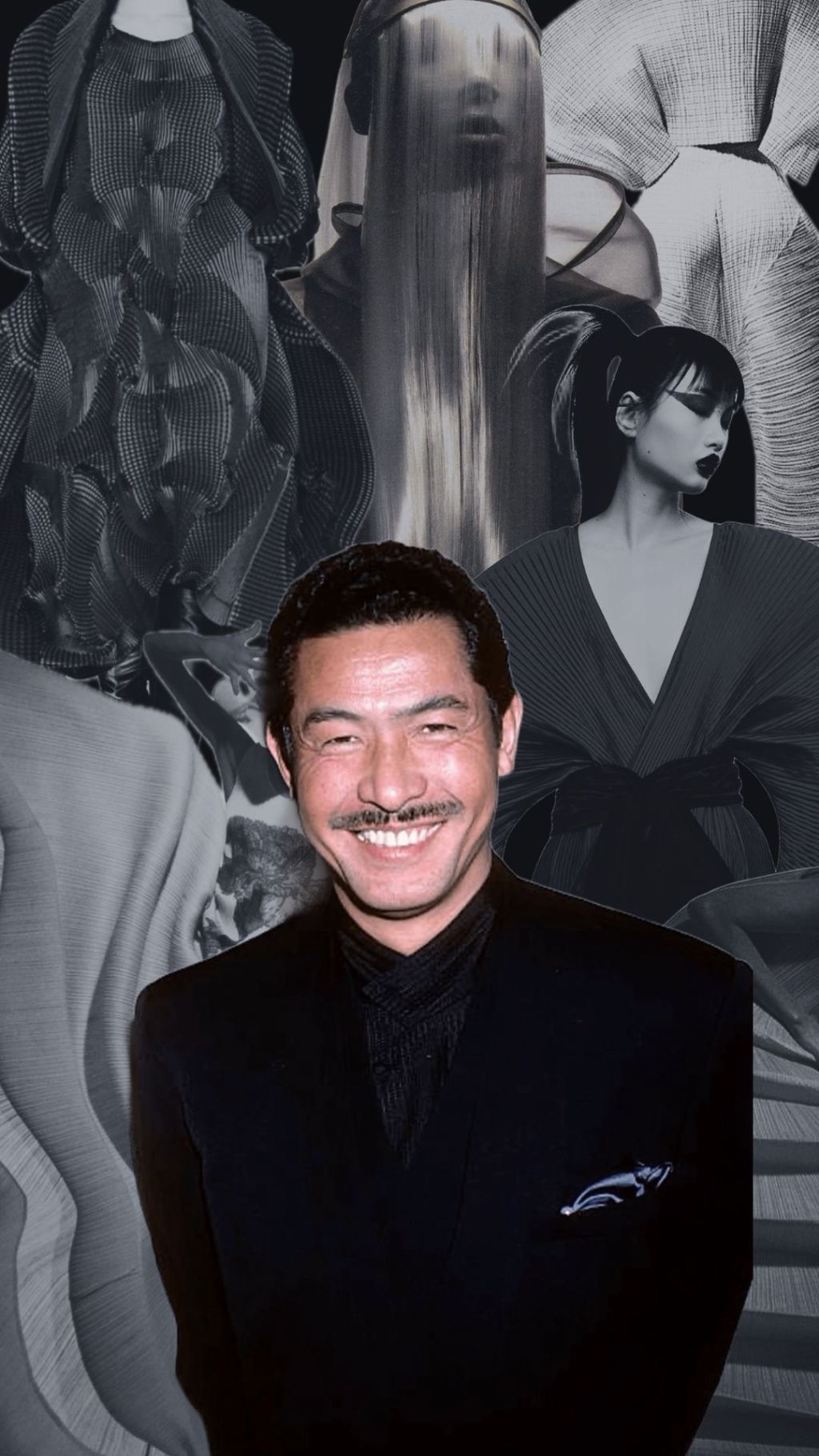
Issued by the Editorial Board, Fashion Law IP Blog.
Most designers begin with a sketch. Issey Miyake began with a question, what if clothing wasn’t meant to decorate the body, but to move with it? What if a garment could fold like paper, expand like architecture, or emerge from a single continuous piece of fabric?
For Miyake, fashion was never simply about appearance. It was a design problem waiting to be solved. Every pleat, fold, seam, and fibre became an opportunity to rethink the relationship between the human body and the objects it wears. Long before words such as innovation, sustainability, and wearable technology became recurring themes in contemporary fashion, Miyake had already begun exploring them through experimentation rather than spectacle.
Unlike many luxury designers remembered for distinctive silhouettes or iconic logos, Miyake built his legacy through ideas. His work drew inspiration from engineering, industrial design, architecture, mathematics, and traditional Japanese craftsmanship, resulting in garments that challenged conventional notions of clothing. Collections such as Pleats Please and A-POC (A Piece of Cloth) were not merely commercial successes, they were demonstrations of how creativity and technology could coexist to transform fashion into a multidisciplinary practice.
This is why Issey Miyake remains one of the most influential designers in modern history. His contribution was never confined to designing clothes. He fundamentally changed how designers think about making them. To study Miyake is therefore not simply to study a fashion designer, but to understand how curiosity, experimentation, and design thinking reshaped the future of fashion itself.
Growing Up in Post-War Japan
Issey Miyake was born in Hiroshima in 1938, a city that would become synonymous with one of history’s greatest human tragedies. At the age of seven, he survived the atomic bombing of Hiroshima, an experience that profoundly shaped his worldview. Remarkably, Miyake rarely spoke publicly about the tragedy, preferring to dedicate his life to creating objects that celebrated optimism, creativity, and human resilience rather than destruction.
Originally studying graphic design at Tama Art University in Tokyo, Miyake demonstrated an interest that extended beyond conventional fashion education. Graphic design exposed him to composition, proportion, geometry, and visual communication, principles that later became central to his approach towards clothing. Rather than treating garments as decorative objects, he increasingly viewed them as carefully engineered compositions capable of interacting with the human body.
Determined to broaden his creative understanding, Miyake travelled to Paris in the 1960s, where he studied at the Chambre Syndicale de la Haute Couture. Paris at the time represented the epicentre of haute couture, dominated by designers such as Guy Laroche, Hubert de Givenchy, and Cristóbal Balenciaga. Although Miyake admired the technical mastery of French couture, he became increasingly convinced that fashion required new methods of thinking. Traditional couture often celebrated exclusivity and ornamentation; Miyake sought innovation, experimentation, and freedom.
His subsequent work in New York further expanded this perspective. Exposure to American industrial production and modern art encouraged him to question how technology could coexist with craftsmanship rather than replace it.
Designing for Movement, Not Mannequins
Perhaps the most defining characteristic of Issey Miyake’s philosophy was his belief that clothing should exist in motion rather than on display.
Unlike designers who began by sketching silhouettes, Miyake frequently started with fabric itself. He believed that textiles possessed their own language and that garments should emerge through experimentation with material, construction, and movement. This approach fundamentally differed from conventional fashion design, where fabric often served merely as a medium for predetermined forms.
Miyake frequently described clothing as an extension of everyday life rather than an object reserved for special occasions. His collections reflected this philosophy by prioritising comfort, flexibility, and interaction. Models did not simply wear his garments; they activated them through movement. Pleats expanded, folded, and reshaped themselves as the body moved, creating an ever-changing relationship between textile and wearer.
This emphasis on movement explains why Miyake’s work is frequently discussed alongside architecture and industrial design rather than solely within fashion history. His garments functioned less like static objects and more like kinetic sculptures.
Pleats Please: When Engineering Became Fashion
Few innovations have transformed contemporary fashion as profoundly as Pleats Please, introduced in the early 1990s.
Although pleated garments had existed for centuries, Miyake revolutionised the process. Rather than pleating fabric before construction, garments were first cut and sewn several sizes larger than intended before being permanently heat-pressed between specialised sheets of paper. This reversed production sequence produced lightweight, wrinkle-resistant clothing capable of retaining its sculptural form regardless of repeated wear or washing.
The significance of Pleats Please extended far beyond aesthetics. It challenged the assumption that luxury clothing must be fragile or difficult to maintain. Instead, Miyake demonstrated that sophisticated design could coexist with practicality.
Equally important was the collection’s democratic philosophy. Unlike haute couture garments designed for exclusive clientele, Pleats Please appealed to individuals of different ages, professions, and lifestyles. The garments travelled easily, adapted to diverse body shapes, and encouraged freedom of movement, reflecting Miyake’s conviction that exceptional design should enhance everyday life rather than remain confined to museum collections.
Today, Pleats Please remains one of the most recognisable innovations in fashion history, admired not only for its visual identity but also for its remarkable integration of textile science, engineering, and artistic expression.
Technology as a Creative Partner
While many designers adopted technology to accelerate production, Miyake embraced it as a creative collaborator. This philosophy reached its most ambitious expression through A-POC (A Piece of Cloth), developed with textile engineer Dai Fujiwara. Using advanced computer programming and industrial knitting technologies, entire garments could be produced from continuous tubes of fabric. Rather than cutting patterns and generating excess waste, wearers could separate individual garments directly from the woven textile according to predetermined guide lines.
A-POC represented a radical departure from conventional garment manufacturing. It challenged assumptions surrounding production, sustainability, and consumer participation by allowing clothing to emerge from a single integrated process rather than numerous fragmented stages.
Similarly, the 132 5. ISSEY MIYAKE project explored mathematical geometry, recycled materials, and three-dimensional folding techniques. Flat geometric forms transformed into sculptural garments when worn, illustrating Miyake’s continuing fascination with the relationship between mathematics, engineering, and fashion.
Long before sustainability became an industry imperative, Miyake’s experiments demonstrated how innovation could reduce waste while simultaneously expanding creative possibilities.
Designing a Way of Life
Issey Miyake’s influence extends well beyond runway collections. Perhaps his most widely recognised creation is the black mock turtleneck worn almost exclusively by Steve Jobs. Rather than functioning as a luxury statement, the garment represented a philosophy of simplicity, consistency, and purposeful design. Jobs reportedly owned dozens of identical Miyake turtlenecks, transforming the garment into one of the most recognisable uniforms in contemporary business culture.
Miyake also collaborated with manufacturers, museums, architects, dancers, photographers, and industrial designers throughout his career. His exhibitions frequently resembled installations rather than traditional fashion presentations, encouraging audiences to engage with garments as artistic objects capable of movement and transformation.
These collaborations reveal an important characteristic of Miyake’s practice: he never regarded fashion as an isolated discipline. Instead, he considered clothing one element within a broader creative ecosystem connecting design, technology, performance, architecture, and everyday living.
Legacy
When Issey Miyake passed away in 2022, the fashion industry lost far more than an influential designer. It lost one of its greatest innovators.
His legacy cannot be measured solely through commercial success or iconic garments. Rather, it lies in the questions he continually asked. Can technology enhance craftsmanship instead of replacing it? Can clothing become more sustainable without sacrificing beauty? Can garments adapt to people rather than forcing people to adapt to garments?
These questions continue to influence contemporary designers working across luxury fashion, textile innovation, and industrial design. Brands increasingly invest in material research, computational design, sustainable manufacturing, and interdisciplinary collaboration, principles Miyake had explored decades earlier.
Conclusion
Issey Miyake never sought to create fashion that merely reflected its time. Instead, he imagined what clothing could become when liberated from convention. His work challenged the assumption that garments should prioritise appearance over function or artistry over practicality. Through pleating technologies, experimental textiles, and revolutionary production methods, he demonstrated that innovation is most meaningful when it improves the relationship between people and the objects they wear.
More importantly, Miyake transformed the role of the fashion designer. He was simultaneously an artist, engineer, inventor, and philosopher, refusing to accept disciplinary boundaries that limited creativity. His garments continue to move, fold, expand, and evolve, not simply because of their construction, but because of the ideas embedded within them.
Issey Miyake did not leave behind a trend to be imitated. He left behind a way of thinking. His greatest creation was never a pleated garment or a revolutionary textile, but a philosophy that treated clothing as an evolving dialogue between the body, material, technology, and imagination. Long after collections fade and seasons pass, Miyake’s ideas continue to unfold, quite literally, in every designer who believes that fashion should not merely be worn, but experienced. His legacy proves that the future of fashion is shaped not by those who follow change, but by those who redefine its very possibilities.
References
- Issey Miyake, ‘Pleats Please’ https://www.isseymiyake.com/en/news/7801.
- Issey Miyake, ‘Pleats Please Issey Miyake’ https://www.isseymiyake.com/en/brands/pleatsplease.
- Issey Miyake Parfums, ‘L’Eau d’Issey’ https://www.isseymiyakeparfums.com/en/women/fragrances.
- NSS Magazine, ‘The History of Issey Miyake’s Pleats’ https://www.nssmag.com/en/fashion/30643/issey-miyake-pleats.
- Dezeen, ‘The Work of Miyake Issey Exhibition Opens in Tokyo’ https://www.dezeen.com/2016/03/16/the-work-of-miyake-issey-exhibition-opens-tokyo/.
- Spoon & Tamago, ‘Tracing the Revolutionary Work of Issey Miyake’ https://www.spoon-tamago.com/2016/03/20/tracing-the-revolutionary-work-of-issey-miyake/.
- The New York Times, ‘The Story Behind Steve Jobs’s Issey Miyake Turtleneck’ (10 August 2022) https://www.nytimes.com/2022/08/10/style/issey-miyake-steve-jobs-black-turtleneck.html.
- The Wall Street Journal, ‘Progressive Dress’ https://www.wsj.com/articles/SB10001424052970204425904578072630303557020.
- Profoto, ‘Albert Watson on Photographing Steve Jobs’ https://profoto.com/int/profoto-stories/albert-watson-steve-jobs.
- Guy Laroche, ‘Heritage’ http://www.guylaroche.com/maison-guy-laroche/heritage/.
- FIDM Museum, ‘Geoffrey Beene’ https://fidmmuseum.org/2018/09/geoffrey-beene.html.
- Vanity Fair, ‘Remembering Hubert de Givenchy’ https://www.vanityfair.com/style/2018/03/hubert-de-givenchy-pat-cleveland.
- Artforum, ‘Isamu Noguchi Becomes First Asian American Artist to Have Work in White House Collection’ https://www.artforum.com/news/isamu-noguchi-becomes-first-asian-american-artist-to-have-work-in-white-house-collection-84515.
- Inamori Foundation English, Message from Issey Miyake – THE 2006 KYOTO PRIZE (YouTube) https://www.youtube.com/watch?v=JVY5p-SHnko.
- KinoLibrary, 1985 Issey Miyake Interview, London, Fashion Designer (YouTube) https://www.youtube.com/watch?v=whxBSwhuQYg.
- VideoFashion, Issey Miyake Fall 1981 Runway & Interview | Videofashion Archives (YouTube) https://www.youtube.com/watch?v=8uF3ddKvpWY.
- Atelier LeonLeon, The Material World of Issey Miyake (YouTube) https://www.youtube.com/watch?v=ljTUS9U0zpc.
- Garik Avetisov, Issey Miyake – Technology of Production of Fabrics (YouTube) https://www.youtube.com/watch?v=ZOAk7QQ_1HQ.
- Garik Avetisov, Issey Miyake – Pleats Please “Flowers” (YouTube) https://www.youtube.com/watch?v=h1l84fxtqHQ.
- Garik Avetisov, Issey Miyake – A-POC Galaxy (YouTube) https://www.youtube.com/watch?v=nVAZQFfVZVM.
- Film Archive of Japan, Bodyworks by ISSEY MIYAKE (YouTube) https://www.youtube.com/watch?v=Dke3qXT1Iiw.
- Paris Modes Studio EN, 132 5. Issey Miyake: A New Concept for Clothes (YouTube) https://www.youtube.com/watch?v=_u2DL3CUJsw.


Leave a Reply