
This article is authored by Saumya Verma, Advisory Board, Fashion Law IP Blog.
Sustainable fashion is not a new concept to India. Lakme Fashion Week has long been a platform for eco-conscious designers, students of NIFT regularly stages on the theme of the revival of handloom and organic textiles, and independent collectives continue to experiment with upcycled collections. It’s worth paying attention to, because a one-day show in Kandy, Sri Lanka, has something India’s fashion calendar still lacks. Sri Lankan first sustainable show has come out of a student-led environmental movement whereas in India sustainable shows have majorly been conducted as an industry event.
A Show Built Differently
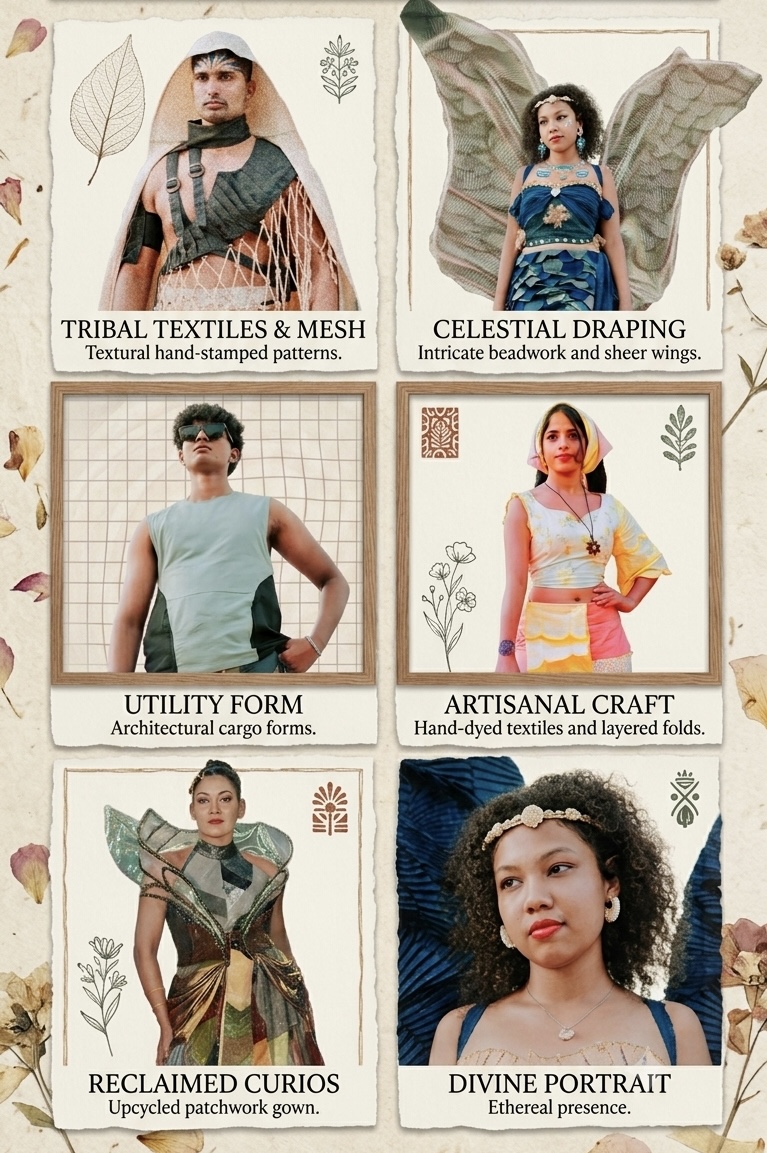
AURORA 2026 was held on 20 June 2026 at Kandy City Centre and was organized entirely by ZeroPlastic University of Peradeniya, a chapter of what is reportedly Sri Lanka’s largest voluntary environmental network, over 12,000 members strong, with more than 150,000 people mobilized nationally. What distinguished the show was not only its sustainability message, but who was behind it. Students did everything including design, production, logistics, creative direction, modelling, technical execution. No outside production house. No professional creative agency swooping in to save the day. The result was a collection of runway-ready pieces crafted almost entirely from recycled, upcycled and waste-derived materials. Media reporting on details of individual pieces of clothing is still thin, but the throughline is clear that everyday waste has been reshaped into structured, wearable clothing that pushes back against fast fashion’s disposable nature. Industry partner MAS Linea Clothing was the main sponsor and SLITA also provided technical support. Crucially, that support appears to have stayed in an advisory lane i.e., the students kept their creative ownership, and a panel of industry experts and academics judged the work on its design merit and sustainability performance. For this event, a commercial mall, not a fashion-industry insider space was utilized; therefore, show reached out to regular shoppers, not the usual fashion-week crowd. That’s a meaningful difference in the public interface from most Indian sustainability showcases, which tend to stay within niche or elite circles.
The Material Philosophy: Resourcefulness or Purity
Where AURORA differs from its Indian counterparts is in its philosophy of raw material. A lot of Indian sustainable shows are based on traditional craft techniques or certified organic fabrics – which are great, but they are based on supply chains and certifications that not every young designer has access to. AURORA, meanwhile, went all in for radical upcycling: discarded plastics, textiles and local urban waste, made into functional, visually compelling garments. AURORA’s approach provides what India’s often doesn’t. A low-barrier entry point and both countries face similar pollution pressures. You don’t need certified organic cotton to get in the game. You need trash, and imagination, and some technical skills. The ‘zero-plastic’ label was more than a marketing technique, it not only affected material selection, but also the production choices along the way. As a result, it provided an authentic model for more rigorous waste hierarchies in design education.
Where India’s Legal System Needs to Modernize
India already has a law for this space i.e., the Plastic Waste Management Rules, 2016; Extended Producer Responsibility (EPR) guidelines and green credit mechanisms. The problem isn’t the absence of the law, it’s how steadily it reaches the grassroots, especially student and early-career designers. AURORA’s model highlights several specific opportunities which encompasses less opaque IP regimes for student inventors. Simplified design registration processes for upcycled work, as well as university incubator structures that clearly establish ownership once industry sponsors such as MAS come on board, would take away much of the ambiguity that currently stops student designers from formalizing their work. Having a runway show inside a shopping mall is not just a logistics choice, it’s a distribution strategy. CSR credit structures or venue-partnership incentives could be used to encourage malls and retail brands to host educational runway events, bringing sustainable design to people who would never go to a fashion week. More in-depth cross-sector partnerships. SLITA and MAS Linea’s strategic involvement in AURORA is a practicable example for NIFT to develop similar industry-NGO collaborations in India, ideally correlating with tangible results such as EPR compliance or sustainability reporting, rather than sporadic sponsorships. India has no shortage of standout sustainable collections. The upcycled denim lines and handloom revival shows have proved that earlier. What is missing is AURORA’s young people led, a multi-faculty model of delivery.
The Bigger Picture
AURORA 2026 wasn’t South Asia’s first sustainable fashion show, but it won’t be the last. What makes it worth studying is the combination of zero-plastic ideology, full student ownership, a mainstream venue strategy and real industry-academic backing, stitched into one replicable template. Not just “showcase more sustainable materials” is the takeaway for India. It’s about putting in place the legal, financial and logistical scaffolding that enables young designers to tackle waste at scale, not just in showcase pieces. That’s policy support for university-led circular design challenges, stronger IP protection of upcycled work and regulatory incentives that reward reaching a mainstream audience, not a niche one. Size will not define the future of South Asia’s fashion. It will be a matter of how smartly the region can turn what it has into something else, and AURORA 2026 is a compelling case study in that direction.
References:
- The New Indian Express. (2024). NIFT Chennai Students Redefine Sustainable Fashion at ‘Shine Beyond Streets’, New Indian Express.
- Sunday Observer. (206). Peradeniya Students Stage Sri Lanka’s First Sustainable Fashion Show, Sunday Obs., https://www.sundayobserver.lk/2026/06/25/peradeniya-students-stage-sri-lankas-first-sustainable-fashion-show/
- Osburg, V.-S., Davies, I., Yoganathan, V., & McLeay, F. (2021). Perspectives, Opportunities and Tensions in Ethical and Sustainable Luxury: Introduction to the Thematic Symposium. Journal of Business Ethics, 169(2), 201–210. http://www.jstor.org/stable/45386763
- Chatterjee, A. (2020). Handcrafting A Sustainable Future: Challenge and Opportunity in a New Millennium. India International Centre Quarterly, 47(1/2), 38–70. https://www.jstor.org/stable/27130924
- Athreya, B. (2022). Can fashion ever be fair? Journal of Fair Trade, 3(2), 16–27. https://www.jstor.org/stable/48676228
- Schiller-Merkens, S. (2017). Will Green Remain the New Black? Dynamics in the Self-Categorization of Ethical Fashion Designers. Historical Social Research / Historische Sozialforschung, 42(1 (159)), 211–237. http://www.jstor.org/stable/44176030
 FASHION LAW
Leave a comment