
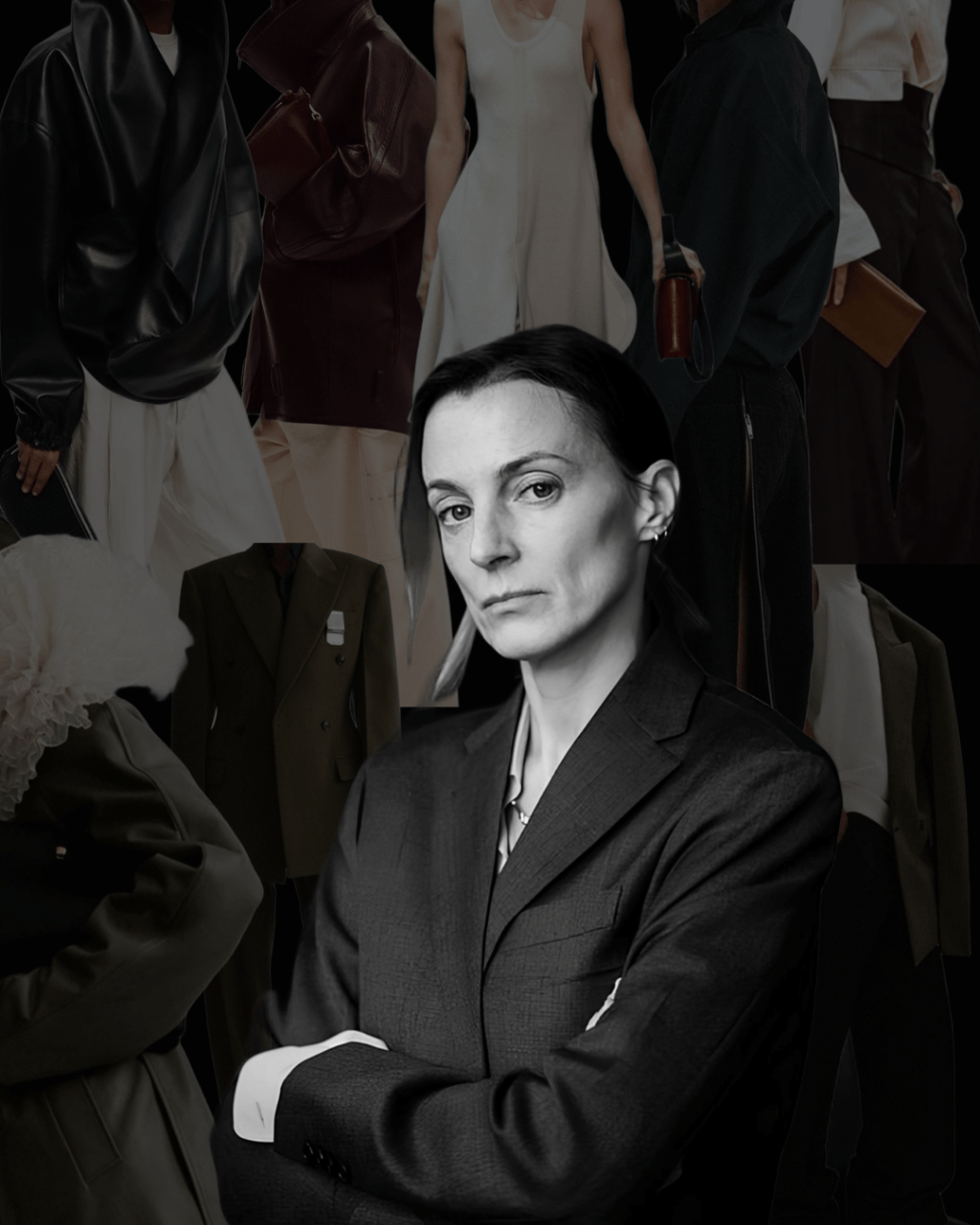
Issued by the Editorial Board, Fashion Law IP Blog.
Fashion has long rewarded excess. Throughout much of the twentieth century, luxury became synonymous with embellishment, recognisable logos, seasonal novelty, and garments designed to command attention. Fashion weeks celebrated spectacle, advertising campaigns glorified aspiration, and consumers were encouraged to believe that luxury was something immediately visible. In such an environment, minimalism often appeared to be the absence of design rather than its highest expression.
Phoebe Philo challenged that assumption.
Without relying on theatrical runway presentations or conspicuous branding, she transformed simplicity into one of the most influential design philosophies of the twenty-first century. Under her creative direction, clothing became quieter yet more expressive, restrained yet more luxurious. Her collections demonstrated that sophistication did not require ornamentation; it required precision. Every seam, proportion, and silhouette served a purpose, creating garments that empowered rather than distracted the wearer.
Today, concepts such as quiet luxury, investment dressing, and timeless wardrobes have become commonplace within the fashion vocabulary. Yet these ideas did not emerge overnight. Long before they became marketing buzzwords, Phoebe Philo was quietly reshaping the relationship between women, luxury, and clothing. Her work proved that fashion could be intellectually engaging without being inaccessible and commercially successful without compromising artistic integrity.
Understanding Phoebe Philo’s contribution, therefore, is not merely an exercise in studying one designer’s career. It is an opportunity to examine how a philosophy rooted in restraint fundamentally altered contemporary fashion and redefined what luxury could look like.
Early Life and Education
Phoebe Philo was born in Paris in 1973 to British parents before growing up in London. Unlike many designers whose childhood stories revolve around couture houses or family ateliers, Philo’s early interests were grounded in observation rather than fantasy. She developed an appreciation for design through everyday life, becoming fascinated by how clothing functioned rather than how dramatically it appeared.
This perspective would later become one of her defining characteristics. Rather than viewing garments as theatrical costumes, Philo regarded them as objects people lived in.
She studied at Central Saint Martins, one of the world’s most influential fashion institutions. During the 1990s, the college produced an extraordinary generation of designers who challenged conventional fashion, including Alexander McQueen, John Galliano, and Hussein Chalayan. While many of her contemporaries became known for dramatic storytelling and avant-garde experimentation, Philo cultivated a markedly different design language. She was interested less in spectacle than in practicality, less in fantasy than in functionality.
Following graduation, she joined Chloé in 1997 as the first design assistant to Stella McCartney. The appointment introduced her to one of Paris’s leading luxury houses and provided an education that extended far beyond garment construction. She witnessed the commercial realities of fashion, the importance of brand identity, and the challenge of balancing creativity with consumer expectations.
When McCartney departed in 2001, Philo was appointed Creative Director at just twenty-seven years of age.
Chloé: Designing for Real Women
At the beginning of the new millennium, luxury fashion often celebrated glamour through highly stylised femininity. Phoebe Philo proposed something remarkably different.
Her collections for Chloé embraced ease rather than restriction. Soft tailoring, relaxed trousers, oversized handbags, flowing dresses, and practical outerwear became central to the brand’s identity. Rather than designing for an imagined ideal, Philo designed for women navigating everyday life.
This seemingly simple shift proved revolutionary.
Fashion critics praised her ability to combine femininity with practicality without sacrificing elegance. Her collections reflected confidence instead of performance, encouraging women to dress for themselves rather than for external approval. Commercially, the strategy was equally successful. Chloé experienced significant financial growth during her tenure, while accessories such as the Paddington Bag became global phenomena.
Yet perhaps more importantly, Philo established the philosophy that would define her entire career: clothing should serve the individual, not overshadow them.
Despite her success, she stepped away from fashion in 2006 following the birth of her children. At a time when creative directors rarely paused their careers, her decision demonstrated an unusual commitment to personal priorities over industry expectations. This temporary absence ultimately strengthened her reputation, reinforcing the authenticity that would later become inseparable from her work.
Reinventing Céline
When LVMH appointed Phoebe Philo as Creative Director of Céline in 2008, the French house occupied a relatively modest position within the luxury market. Although respected, it lacked a distinct contemporary identity.
Philo’s arrival fundamentally changed that trajectory. Her debut collection, presented for Autumn/Winter 2010, immediately signalled a departure from prevailing luxury aesthetics. The runway featured sharply tailored coats, architectural silhouettes, monochromatic palettes, luxurious knitwear, and impeccably constructed leather goods. Instead of elaborate decoration, the garments relied upon proportion, material quality, and craftsmanship.
The presentation itself reflected this philosophy. There was little theatricality, minimal distraction, and no attempt to overwhelm the audience. Every element directed attention towards the clothes themselves.
Critics quickly recognised that something significant had occurred. Céline was no longer simply another Parisian luxury house, it had become the defining expression of contemporary minimalism.
Under Philo, the brand cultivated a visual language based upon clean lines, muted colours, and exceptional tailoring. Accessories such as the Luggage Tote, Trio Bag, and Trapeze Bag became international icons, not because they displayed prominent logos, but because their design was immediately recognisable.
Ironically, by rejecting overt branding, Philo created one of fashion’s strongest brand identities.
How Phoebe Philo Made Minimalism Desirable
Minimalism had existed within fashion long before Phoebe Philo. Designers such as Jil Sander, Helmut Lang, and Calvin Klein had all explored reduction as an aesthetic principle. What distinguished Philo was her ability to transform minimalism from a stylistic preference into a cultural aspiration.
She understood that simplicity requires extraordinary precision. When decoration is removed, proportion becomes more important. When colour is limited, fabric quality becomes more noticeable. When logos disappear, craftsmanship becomes the primary form of communication.
Her collections therefore demanded perfection in every detail. This philosophy also altered the psychology of luxury consumption. Rather than encouraging customers to purchase statement pieces for individual seasons, Philo advocated wardrobes composed of enduring essentials. Crisp white shirts, perfectly tailored trousers, oversized wool coats, structured leather bags, and finely knitted cashmere became objects of long-term investment rather than seasonal trends.
Luxury, in Philo’s world, was measured through longevity rather than visibility. This approach proved remarkably influential. Fashion journalism increasingly celebrated “capsule wardrobes,” “investment dressing,” and “timeless essentials.” The language surrounding luxury gradually shifted away from conspicuous consumption towards permanence, craftsmanship, and versatility.
Years before the phrase “quiet luxury” entered popular culture, Phoebe Philo had already demonstrated what it looked like.
The Rise of the ‘Philophiles’
Few contemporary designers have cultivated the kind of devoted following that surrounded Phoebe Philo.
Her admirers, widely known as Philophiles, extended far beyond conventional fashion consumers. Architects, artists, academics, editors, entrepreneurs, and creative professionals embraced her work because it reflected their values as much as their personal style.
For many women, wearing Céline under Philo represented participation in an intellectual rather than purely aesthetic movement.
Advertising campaigns reinforced this identity. Rather than relying exclusively on young fashion models, Philo featured respected cultural figures such as author Joan Didion. The campaign challenged long-standing assumptions regarding age, beauty, and desirability within luxury advertising while simultaneously communicating that intelligence itself could become aspirational.
This cultural positioning distinguished Céline from many of its competitors. The brand did not promise transformation through glamour. Instead, it promised confidence through thoughtful design.
As fashion increasingly accelerated through social media and rapidly changing trends, Philo offered an alternative based upon permanence, restraint, and authenticity.
The Return of Phoebe Philo
Following her departure from Céline in 2017, the fashion industry entered an unusually prolonged period of anticipation.
Designers regularly launch new collections every six months. Yet for several years, one of fashion’s most influential figures remained silent. Rather than diminishing her relevance, the absence elevated it.
When Phoebe Philo announced her independent label in 2021, excitement spread throughout both industry circles and consumer communities. The launch represented more than the return of a celebrated designer, it symbolised the continued demand for thoughtful fashion in an increasingly saturated marketplace.
Her independent collections retained the principles that had defined her earlier work, architectural tailoring, refined materials, sculptural silhouettes, and uncompromising craftsmanship, while allowing even greater creative autonomy.
The response confirmed that her influence had never truly disappeared.
Conclusion
Fashion often celebrates designers who create the loudest statements. Phoebe Philo achieved something far more difficult.
She convinced an industry built upon constant visibility that restraint could be just as compelling. She demonstrated that luxury need not announce itself through logos, embellishment, or spectacle, but could instead emerge through proportion, craftsmanship, intelligence, and purpose.
Her greatest contribution was not simply making minimalist clothing fashionable. It was changing what people expected fashion to communicate. After Phoebe Philo, simplicity was no longer perceived as the absence of creativity; it became evidence of confidence. The quietest garments suddenly carried the loudest ideas.
That is why her work continues to influence designers, consumers, and luxury brands alike. Trends inevitably fade, but philosophies endure. And few philosophies have reshaped contemporary fashion as profoundly as Phoebe Philo’s belief that, when every unnecessary element is removed, what remains is not less fashion, but its purest form.
References
- Sarah Mower, ‘Phoebe Philo in Her Own (Few) Words’, Vogue (22 December 2017) https://www.vogue.com/article/philo-words.
- Phoebe Philo, ‘Phoebe Philo’, The Gentlewoman No 1 (2010) https://thegentlewoman.co.uk/library/phoebe-philo.
- Vanessa Friedman, ‘Phoebe Philo Exits Céline, Adding to Fashion Turmoil’, The New York Times (22 December 2017) https://www.nytimes.com/2017/12/22/fashion/phoebe-philo-celine.html.
- Sleek Magazine, ‘How Phoebe Philo Brought Female Empowerment Back to High Fashion’ (9 October 2017) https://sleek-mag.com/article/phoebe-philo-female-empowerment/.
- Rory Satran, ‘A Cultish Designer Returns. Fans Prepare for “Financial Devastation.”’, The Wall Street Journal (5 August 2023) https://www.wsj.com/style/fashion/phoebe-philo-return-fc69fbfa.
- Gaudenzi Boutique, ‘Phoebe Philo: The Visionary of Minimalism’ (7 March 2025) https://blog.gaudenziboutique.com/brands-we-love/phoebe-philo-the-visionary-of-minimalism.
- Phoebe Philo, Official Website https://www.phoebephilo.com/.
- The Business of Fashion, ‘Phoebe Philo’ https://www.businessoffashion.com/people/phoebe-philo/.


Leave a Reply