
Issued by the Editorial Board, Fashion Law IP Blog.
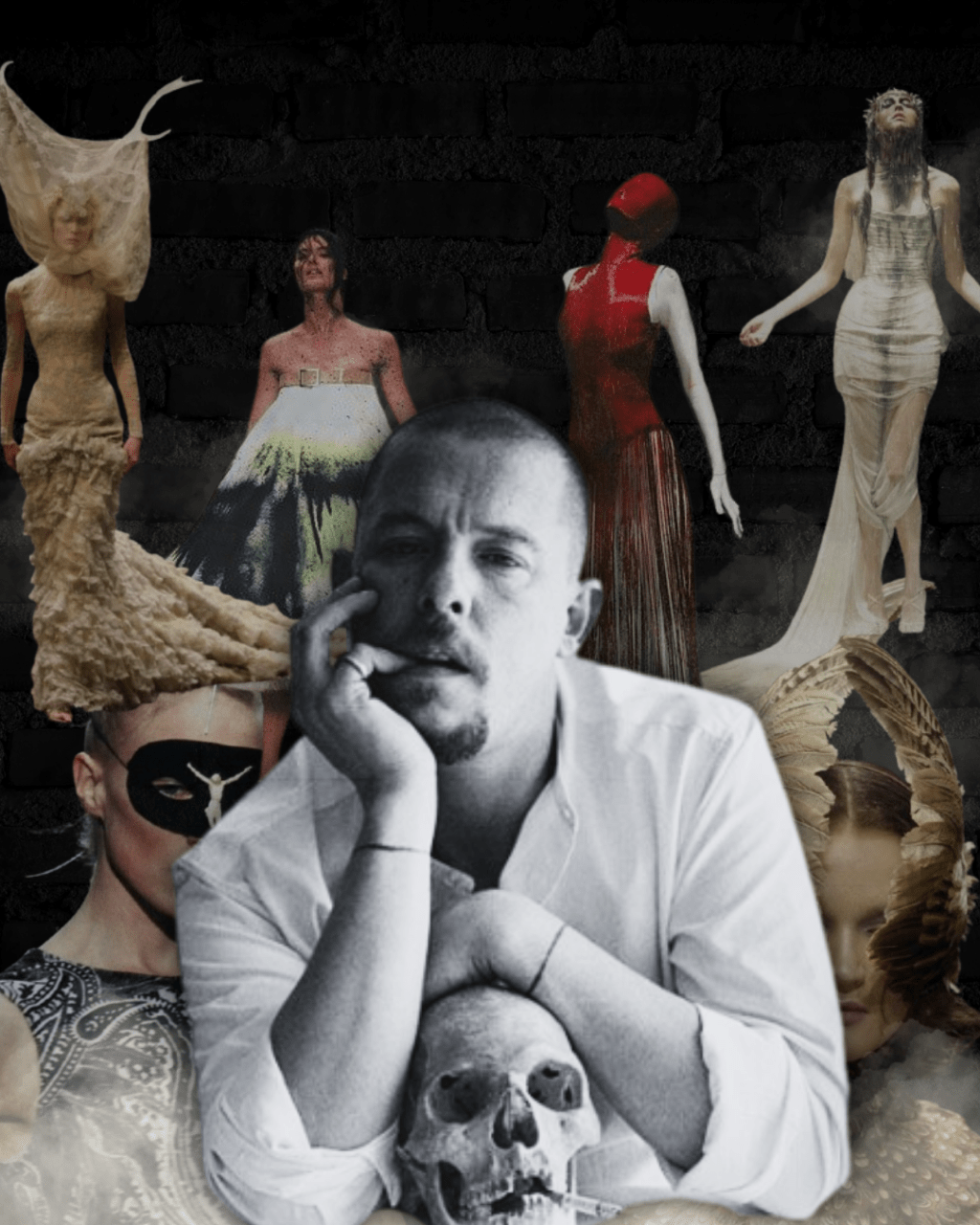
When fashion shocks, the shock is usually temporary, a dramatic silhouette, an unusual fabric, an unexpected casting choice. Alexander McQueen approached this differently. He treated the runway less as a place to display clothes and more as a place where clothes could confront the viewer.
His work could be beautiful, but it was rarely comfortable. It brought together tailoring and violence, romance and death, technology and the body, history and fantasy. A McQueen collection could ask questions about sexuality, class, identity, power, nature and mortality without necessarily providing an answer. The clothes were important, but so were the circumstances in which they appeared: the music, the models, the staging, the lighting and the narrative.
This was what made McQueen’s work dangerous. He did not simply expand the vocabulary of fashion; he challenged the assumption that fashion’s primary responsibility was to make people look beautiful.
From Savile Row to the Runway
Lee Alexander McQueen was born in London in 1969 and trained initially through the traditional discipline of tailoring. He worked on Savile Row before moving through costume and theatrical environments and eventually studying at Central Saint Martins. That training became fundamental to his later practice. His work was radical in subject matter, but it was supported by an unusually rigorous understanding of cutting and construction.
His 1992 postgraduate collection, Jack the Ripper Stalks His Victims, already contained the central characteristics that would define his career: historical reference, narrative, sexuality, violence and meticulous tailoring. The Metropolitan Museum of Art later identified the collection as the beginning of McQueen’s distinctly narrative and autobiographical approach to design.
McQueen was subsequently associated with Isabella Blow, the influential fashion editor who purchased his graduation collection and became an important figure in his early career. His first collection after graduating,
Taxi Driver (Autumn/Winter 1993–94), introduced the now-famous “bumster” trousers, which radically lowered the waistline and exposed part of the lower back and buttocks.
The garment was more than an exercise in provocation. McQueen was challenging the accepted relationship between the body and clothing. Rather than using clothing to conceal or conventionally flatter the body, he manipulated the silhouette to make the body itself unfamiliar.
When Provocation Became a Method
McQueen’s early collections established an approach in which controversy was not incidental to fashion; it could become part of its meaning.
The most important example was Highland Rape (Autumn/Winter 1995–96). The collection drew upon McQueen’s Scottish heritage and the historical violence associated with the English treatment of Scotland, including the Jacobite risings and Highland Clearances. The garments incorporated tartan, slashing and distressed construction, creating an intentionally violent visual vocabulary.
The title, however, created a different kind of controversy because many viewers interpreted “rape” as referring to sexual violence against women. McQueen explained that he intended the term to refer to the historical “rape” of Scotland by England, but the collection remained subject to criticism concerning its representation of women’s bodies and sexual violence.
This ambiguity became characteristic of McQueen. His shows did not always tell audiences what to think. They placed viewers in an uncomfortable position and required interpretation.
That is an important departure from conventional fashion communication. Advertising generally seeks clarity: the product should be desirable, the brand should be recognisable and the consumer should understand the message. McQueen’s runway often did the opposite. The ambiguity was the message.
Fashion as Theatre
McQueen understood that a garment experienced on a runway was fundamentally different from a garment seen on a rack.
His collections frequently began with a concept for the presentation itself. According to the Metropolitan Museum’s documentation of his practice, McQueen would develop elaborate storyboards drawing upon references from art, film and music before the clothing was fully developed. His garments were also frequently constructed directly on the mannequin during fittings, making the body an essential part of the design process. This transformed the fashion show into a form of performance.
In VOSS (Spring/Summer 2001), for example, McQueen constructed a mirrored chamber that initially reflected the audience rather than revealing the models inside. The presentation eventually exposed a disturbing tableau, turning the conventional relationship between audience and spectacle on its head.
The runway was no longer simply a platform. It became part of the work. This is one reason McQueen is increasingly discussed alongside installation and performance art.
The Metropolitan Museum’s Savage Beauty exhibition described his work as extending fashion into conceptual expressions of culture, politics and identity, while recognising the narrative structures and avant-garde installation qualities of his runway presentations.
Beauty, Violence and the Body
McQueen’s relationship with the body was never straightforward. He could make the body appear powerful, vulnerable, aggressive or almost inhuman. Corsetry, exaggerated silhouettes, sharply constructed tailoring and distorted proportions repeatedly transformed the relationship between garment and wearer.
His work therefore questioned one of fashion’s oldest assumptions: that clothing exists primarily to make the body more conventionally attractive. For McQueen, the body could instead become a site of conflict.
This was particularly evident in his treatment of women. His work has generated competing interpretations: some critics have regarded his imagery as misogynistic or exploitative, while others have understood the violence and vulnerability in his work as a critique of power rather than a celebration of it. The continuing debate is significant because McQueen rarely offered an uncomplicated position.
His models could appear simultaneously threatened and threatening. That tension became one of the defining characteristics of his aesthetic.
Technology Enters the Theatre
McQueen’s work was not confined to historical references and traditional craftsmanship. He was equally interested in technology and the possibility that technological innovation could transform the fashion image.
One of the clearest examples came with No. 13 (Spring/Summer 1999). During the finale, model Shalom Harlow stood on a rotating platform while industrial robotic arms sprayed her white dress with paint. The machinery transformed the garment in real time, making the act of creation itself part of the performance. Here, technology did not merely assist the designer. Technology became part of the spectacle.
McQueen was interested in what happened when the controlled precision of machinery encountered the unpredictability of the human body. The result was simultaneously beautiful and unsettling.
His final fully realised collection, Plato’s Atlantis (Spring/Summer 2010), pushed this relationship even further. Inspired partly by Darwinian ideas of evolution, the collection imagined a future in which human beings had evolve, or devolved into forms adapted to an altered environment. The silhouettes suggested aquatic and reptilian bodies, while digitally engineered prints and extraordinary footwear created a visual language that seemed to exist somewhere between biology and science fiction.
The collection was also streamed live on SHOWstudio, making technology part of not only the clothes but also their distribution and reception. The Metropolitan Museum described this use of the Internet as an attempt to create an interactive dialogue between designer and audience.
McQueen therefore understood something that would become increasingly important to fashion in the digital age; the runway itself could become a technological medium.
The Natural World and the Sublime
Although McQueen is often remembered for darkness and provocation, his work was equally fascinated by nature.
The Metropolitan Museum identifies nature as one of the most enduring influences on his practice. His collections explored animals, insects, landscapes, organic materials and the relationship between human beings and the natural world.
But McQueen did not necessarily present nature as peaceful. Nature in his work could be beautiful precisely because it was dangerous.
This distinction helps explain why the term “savage” became so appropriate to the later interpretation of his work. His aesthetic repeatedly moved between attraction and fear. Feathers could become threatening. Flowers could appear decayed. Organic forms could become monstrous. The human body could resemble an animal, while machines could begin to resemble living organisms.
His fascination with the natural world therefore became another way of destabilising the boundary between beauty and danger.
Why Fashion Needed McQueen
McQueen’s importance lies partly in what he allowed fashion to become. He demonstrated that a collection could operate simultaneously as clothing, performance, narrative, sculpture, cultural commentary and technological spectacle. His work brought together the traditions of Savile Row tailoring and haute couture with techniques and references drawn from contemporary art, popular culture, technology and historical research.
The result was not always commercially comfortable or aesthetically safe. But perhaps fashion did not need to be safe.
McQueen challenged the idea that fashion should merely anticipate what consumers wanted. Instead, he used fashion to produce questions that consumers, or audiences, had not necessarily expected to encounter in a runway show.
That approach also changed the status of the fashion designer. McQueen increasingly occupied the position of author, director and storyteller. The collection became an authored world rather than a simple assortment of garments.
His influence was subsequently institutionalised. The Metropolitan Museum’s Alexander McQueen: Savage Beauty exhibition in 2011 examined his nineteen-year career, from his 1992 Central Saint Martins collection through his final presentation. The exhibition positioned his designs within a broader history of culture, politics and identity, treating fashion as a medium capable of carrying ideas far beyond utility.
The exhibition later travelled to the Victoria and Albert Museum in London, where it became the museum’s most visited exhibition at the time, demonstrating the extraordinary cultural reach that McQueen’s fashion had acquired.
The Meaning of “Dangerous”
To describe McQueen as dangerous is not simply to describe his clothes as shocking. His real danger was intellectual.
He made audiences question why fashion needed to be beautiful. He challenged the relationship between clothing and the body, between designer and audience, between technology and craft, and between fashion and art. He demonstrated that a runway could frighten an audience as easily as it could seduce one.
And that is why McQueen’s legacy extends beyond particular garments. The bumster, the corset, the tartan, the razor-sharp tailoring and the extraordinary shoes remain recognisable, but they are fragments of a larger philosophy, fashion could be used to disturb perception.
His career was tragically short. He died in February 2010, shortly before the completion of the final chapter of his work. His Autumn/Winter 2010 collection was subsequently completed by Sarah Burton, who had worked alongside him for many years. Yet the question McQueen posed remains remarkably contemporary.
In an industry increasingly dominated by commercial safety, algorithmic visibility and instantly consumable aesthetics, perhaps the most radical thing a designer can still do is make the audience uncomfortable.
Conclusion
Alexander McQueen did not make fashion dangerous because he filled it with darkness, death or controversy. He made it dangerous because he refused to let fashion remain intellectually comfortable.
He treated the garment as a starting point rather than an endpoint. A dress could become a memory, a political statement, a technological experiment, a sculpture, a weapon, a performance or a confrontation with mortality.
That is why his work continues to resist easy classification. McQueen understood that fashion becomes culturally powerful when it stops merely answering the question, “What should we wear?” and begins asking more difficult questions about who we are, how we see the body, what we consider beautiful and why we are afraid of what challenges those ideas.
Perhaps that is the real meaning of danger in fashion, not the ability to shock us for a moment, but the ability to change what we are willing to see.
If fashion can make us question beauty, identity and the body itself, was Alexander McQueen really making dangerous clothes, or was he making us dangerous enough to question fashion?
References
- Andrew Bolton, Alexander McQueen: Savage Beauty (Metropolitan Museum of Art and Yale University Press 2011).
- Claire Wilcox, Alexander McQueen (V&A Publishing 2015).
- Caroline Evans, Fashion at the Edge: Spectacle, Modernity and Deathliness (Yale University Press 2003).
- Judith Watt, Alexander McQueen: The Life and Legacy of a Celebrated Designer (HarperCollins 2012).
- Andrew Wilson, Alexander McQueen: Blood Beneath the Skin (Simon & Schuster 2015).
- Katherine Gleason, Alexander McQueen: Evolution (Race Point Publishing 2012).
- Alexander McQueen: Savage Beauty, The Metropolitan Museum of Art (New York, 4 May–7 August 2011).
- Alexander McQueen: Savage Beauty, Victoria and Albert Museum (London, 14 March–2 August 2015).
- Victoria and Albert Museum, ‘Alexander McQueen – an introduction’ (V&A) (2024).
- Metropolitan Museum of Art, ‘About the Exhibition: Alexander McQueen: Savage Beauty’ (2011).
- Metropolitan Museum of Art, ‘Selected Objects from the Exhibition: Alexander McQueen: Savage Beauty’ (2011).
- Victoria and Albert Museum, Alexander McQueen: Savage Beauty – Exhibition Outline (2015).
- Metropolitan Museum of Art, ‘661,509 Total Visitors to Alexander McQueen Put Retrospective among Top 10 Most Visited Exhibitions in Metropolitan Museum’s History’ (8 August 2011).
- Victoria and Albert Museum, Alexander McQueen: Savage Beauty – Teachers’ Resource (2015).


Leave a Reply