
This article is authored by Aminesh Nayan Gogoi, Editor-in-Chief, Fashion Law IP Blog.
Batman has changed his suit more often than most people change their idea of what a hero should look like. That is not an accident.
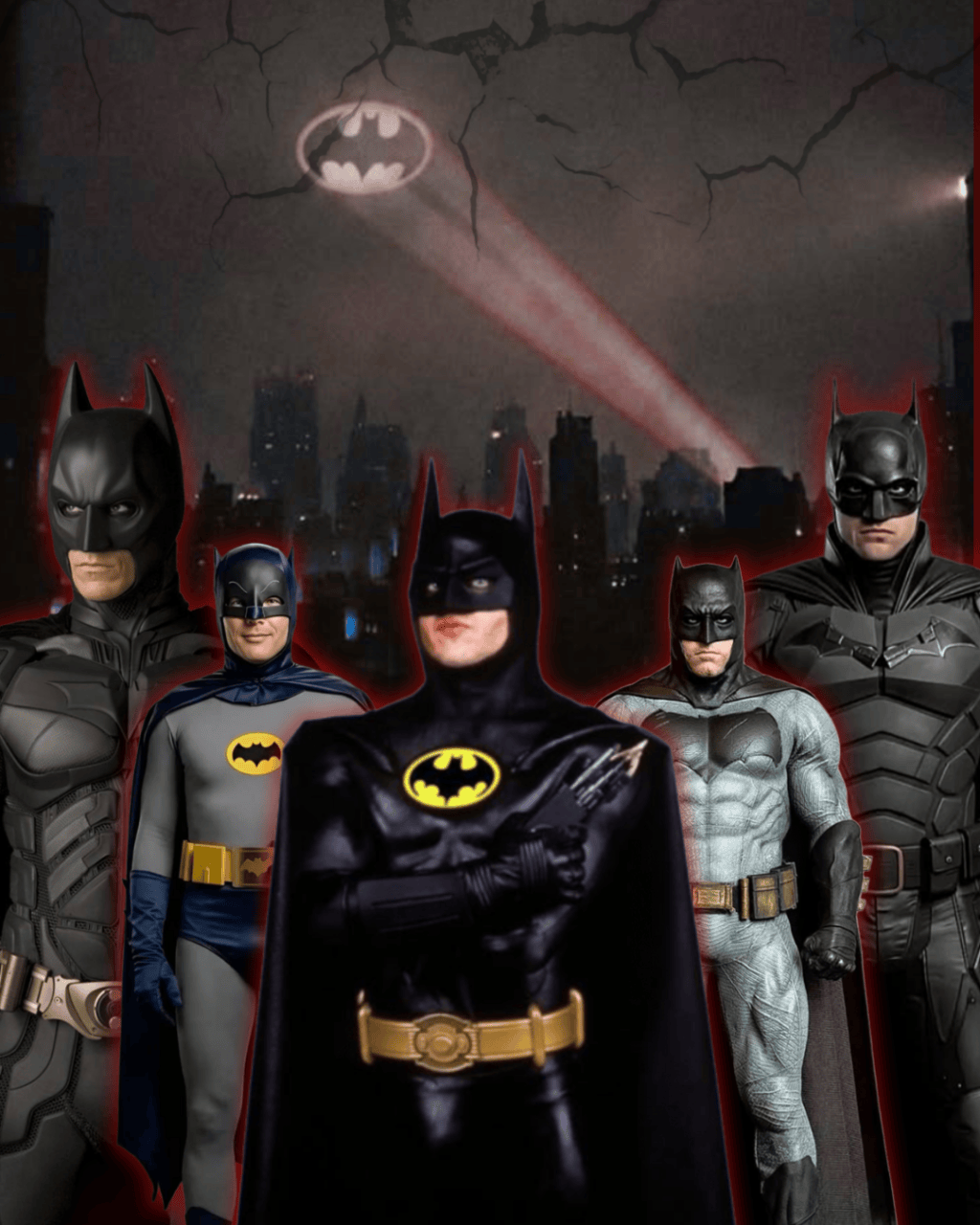
Put Adam West’s Batman beside Robert Pattinson’s and the difference is almost absurd. One looks as though he has stepped out of a brightly coloured comic strip; the other appears to have assembled himself from armour, motorcycle equipment, military materials and unresolved trauma. Yet both are immediately recognisable as Batman. The face is different. The body is different. The technology is different. The cultural moment is different. The silhouette survives.
That is what makes Batman’s costume particularly interesting from the perspective of fashion and design. The Batsuit is not merely clothing used to dress an actor. Across decades of live-action cinema, it has functioned as a visual language through which filmmakers communicate who Batman is, what Gotham represents, what technology means in that particular era, and what audiences are expected to fear, or admire.
The history of the Batsuit is consequently also a history of Batman himself. And perhaps the most revealing question is not which Batsuit looks best? It is what does each Batsuit tell us about the man underneath it?
Adam West: When Batman Was Allowed to Be Fun
When Adam West appeared as Batman in the 1966 television series and film, the character looked unmistakably like a comic-book superhero.
The grey bodysuit, blue-black cape and cowl, yellow-and-black emblem and bright yellow utility belt translated the graphic language of the comics directly onto the screen. The costume was conspicuous rather than threatening. It announced itself. This Batman did not need to disappear into Gotham’s shadows. He belonged to television.
The design also reflected the cultural character of the series itself. Batman was colourful, theatrical and deliberately exaggerated. The visible fabric and relatively simple construction reinforced the idea that audiences were watching a heightened version of the comic-book world rather than a supposedly realistic vigilante. The famous yellow ellipse around the Bat-symbol further emphasised the emblem as a graphic device.
Most importantly, West’s costume made Batman accessible. He was mysterious, but not frightening. He was heroic, but also humorous. His costume did not suggest psychological instability or military preparation. It suggested performance.
In retrospect, the 1966 Batsuit tells us something important about the superhero genre itself. Batman did not always need to be dark to be Batman. Then Hollywood decided that he did.
Michael Keaton: The Birth of the Dark Knight
Tim Burton’s Batman (1989) did not simply redesign the Batsuit. It redesigned the cultural meaning of Batman.
The transformation was immediate. The colourful television costume disappeared beneath black sculpted armour. Bob Ringwood, the film’s costume designer, studied hundreds of Batman comics while developing the costume, while the production experimented with numerous sculpted designs, heads and cape configurations. The challenge was particularly significant because Michael Keaton did not possess the enormous physical proportions traditionally associated with Batman. The costume therefore had to construct a larger-than-life silhouette around him. The result was less superhero uniform and more mythological armour.
The black surface absorbed light. The rigid cowl restricted movement. The enlarged chest and shoulders transformed Keaton’s relatively compact frame into something imposing. Even the discomfort became part of the performance. The suit was designed to make Batman appear physically different from Bruce Wayne. Once inside it, Keaton’s body became more rigid, more controlled and more intimidating. This was Batman as urban creature.
Burton’s Gotham was gothic, industrial and psychologically unstable, and the costume responded accordingly. Batman no longer looked like a man attending a costume party with crime-fighting equipment. He looked like something Gotham itself had produced. The Batsuit had become architecture.
Christian Bale: When the Costume Became Technology
Christopher Nolan’s Batman Begins (2005) introduced another decisive transformation. If Burton’s Batman was mythological, Christian Bale’s Batman was engineered.
Costume designer Lindy Hemming approached the Batsuit through contemporary technology, military equipment, performance fabrics and methods of construction. The suit was built around a flexible neoprene base with moulded components, while its design was intended to allow significantly greater movement than earlier versions. Hemming has described researching military technology and newly available fabrics and even identifying sports footwear as an inspiration for the suit’s construction.
This was an important conceptual shift. Bruce Wayne no longer simply became Batman by putting on a costume. He built Batman.
The Batsuit consequently became an extension of Wayne’s technological resources, intelligence and strategic thinking. The cape, armour, cowl and gauntlets were no longer merely aesthetic components; they appeared to have a practical purpose within the world of the film.
The costume therefore reinforced Nolan’s larger project. Batman had to exist within a world that audiences could believe. The transformation continued in The Dark Knight (2008). The costume was redesigned to increase mobility, particularly around the head and neck, while incorporating a far more complex construction. Production materials describe a transition from three principal components in Batman Begins to more than 100 individual pieces in the second film. That detail is revealing. The suit became more sophisticated because Batman himself had become more sophisticated. The costume was no longer merely protection. It was equipment. And that distinction would become increasingly important.
Ben Affleck: Batman as a Weapon
Ben Affleck’s Batman in Batman v Superman: Dawn of Justice (2016) initially appears to move backwards.
The suit is grey and black. The silhouette is enormous. The design draws substantially from Frank Miller’s The Dark Knight Returns. It looks closer to the printed Batman than Nolan’s technologically streamlined version. But this Batman is not a return to simplicity. He is a weaponised Batman.
Zack Snyder’s interpretation presents Bruce Wayne as an older, physically imposing and deeply damaged vigilante. The costume therefore emphasises mass rather than agility.
The visual message is blunt. This Batman does not need to outrun you. He needs to overpower you. That becomes particularly significant when Batman prepares to confront Superman. The existence of a specialised armoured suit demonstrates that the costume is capable of responding to narrative circumstances. Batman’s clothing becomes strategy.
The costume changes because the enemy changes. This is one of the most fascinating characteristics of superhero costume design: clothing can function as narrative evidence. A different suit tells us that the character has entered a different problem.
Affleck’s Batman also demonstrates the tension between fictional functionality and real-world costume construction. The suit was intended to communicate physical power and protection, but the actual experience of wearing such costumes can be radically different. Affleck later described the Batsuit as extremely uncomfortable, illustrating an intriguing divide between the apparent functionality of superhero clothing and the physical realities of costume production and performance.
The audience sees armour. The actor experiences heat. Fashion, in other words, still wins the argument.
Robert Pattinson: The Batsuit Becomes Personal
Then came The Batman (2022), and the Batsuit became something altogether different. Robert Pattinson’s Batman is younger, less complete and considerably more obsessive. His suit reflects that psychological state.
Designed by Glyn Dillon and David Crossman, the costume deliberately pursued realism and practicality. The designers drew inspiration from military clothing, including Vietnam-era protective equipment, while creating a silhouette that would allow Pattinson to fight and move more naturally. Approximately twenty final versions of the suit were produced during development.
But the most important quality is not its technology. It is its imperfection. The suit looks constructed rather than manufactured. The armour appears assembled. The materials appear repurposed. The cowl feels severe rather than polished. The overall appearance suggests a young man attempting to manufacture a symbol before he has completely understood what that symbol should mean. That is entirely appropriate. Pattinson’s Batman is not yet the finished mythology. He is becoming Batman.
Even the colour treatment reflects this intention. The designers used different levels of black and grey so that the suit would retain visual definition rather than disappearing into darkness on camera. The result is perhaps the most contemporary Batsuit precisely because it does not look futuristic. It looks possible.
When Clothing Becomes Character
Across these interpretations, the Batsuit has moved through several distinct design philosophies. Adam West’s costume was graphic. Michael Keaton’s was sculptural. Christian Bale’s was technological. Ben Affleck’s was militarised. Robert Pattinson’s is personal and improvised.
These differences are not merely aesthetic. They correspond to different understandings of Batman. West’s Batman belongs to a world of television spectacle and comic-book fantasy. Keaton’s belongs to gothic mythology. Bale’s belongs to a technologically rationalised modern city. Affleck’s belongs to an exhausted world of violence and superhuman threats. Pattinson’s belongs to a contemporary Gotham in which Batman is still trying to understand whether vengeance can become justice.
The costume communicates these distinctions before Batman says a word. That is precisely why costume design deserves to be taken seriously within fashion and visual culture.
The Fashion Law Question: Who Owns the Look?
There is another reason Batman’s costume makes an unusually interesting case study for fashion law. The Batsuit occupies an uncomfortable space between clothing, graphic design, character identity and intellectual property.
A garment can be functional. A fictional character can be protected through copyright. Graphic elements can potentially function as trademarks. A recurring visual configuration can become so strongly associated with a character that it operates as a form of commercial identity.
Batman sits at the intersection of all three. The Bat-symbol is not merely decoration. It operates as an immediately recognisable identifier of Batman and, commercially, as part of the broader DC brand ecosystem.
The same is true of the cowl, cape and characteristic silhouette. This raises a fascinating question for fashion law: At what point does clothing stop being clothing and become character identity?
The question becomes even more complicated when different designers repeatedly reinterpret the same fictional character. Bob Ringwood’s Batman does not look like Lindy Hemming’s. Hemming’s does not look like Michael Wilkinson’s. Wilkinson’s does not look like Dillon and Crossman’s. Yet all of them are recognisably Batman.
The designers therefore work within an established visual identity while simultaneously being expected to reinvent it. That is remarkably similar to a problem encountered throughout fashion: how do you innovate within an existing brand language without destroying the identity that made the brand recognisable in the first place?
The Costume Is the Continuity
Batman has been rebooted, recast and reinterpreted repeatedly. Yet the costume provides an extraordinary form of continuity. The materials change. The colours change. The construction changes. The technology changes. The body underneath changes. But certain visual elements remain. The ears. The cape. The emblem. The silhouette. The darkness.
These components form a visual grammar through which Batman can be repeatedly rewritten without becoming unrecognisable. That is why the Batsuit is more than a costume. It is a design system. It allows each generation to ask what Batman means while retaining enough visual continuity for audiences to understand that they are still looking at the same cultural figure.
The Man Behind the Mask
Perhaps the most interesting conclusion is that Batman’s costume has never simply reflected changing fashion. It has reflected changing anxieties about masculinity, technology, violence, heroism and identity.
Adam West’s Batman could afford to be theatrical. Keaton’s needed to be frightening. Bale’s needed to be believable. Affleck’s needed to be formidable. Pattinson’s needed to look unfinished.
The Batsuit changes because Batman changes. And yet Batman remains recognisable because the costume preserves the visual identity beneath those changes. It tells us which Batman we are watching.
The next time a new actor puts on the cowl, the question therefore should not simply be whether the suit looks good. It should be, what does this Batman’s costume tell us about the world that created him?
References
1. Christopher Nolan, Batman Begins (Warner Bros Pictures 2005).
2. Christopher Nolan, The Dark Knight (Warner Bros Pictures 2008).
3. Christopher Nolan, The Dark Knight Rises (Warner Bros Pictures 2012).
4. Tim Burton, Batman (Warner Bros Pictures 1989).
5. Tim Burton, Batman Returns (Warner Bros Pictures 1992).
6. Zack Snyder, Batman v Superman: Dawn of Justice (Warner Bros Pictures 2016).
7. Matt Reeves, The Batman (Warner Bros Pictures 2022).
8. ‘When Batman Went “Bam!” and “Pow”’ Smithsonian Magazine (11 January 2016).
9. ‘What the Batmobile Tells Us About the American Dream’ Smithsonian Magazine (2018).
10. Lindy Hemming, ‘Interview: Lindy Hemming, Costume Designer’ Sci-Fi Bulletin (2017).
11. Christopher Laverty, ‘The Dark Knight Rises: Costume Q&A with Lindy Hemming’ Clothes on Film (31 May 2021).
12. ‘His Derring Do-Over’ Los Angeles Times (20 July 2008).
13. Christopher Nolan, interview with Batman-on-Film (2008).
14. Daron James, ‘How “The Batman” Batsuit Designers Went Lean & Mean’ The Credits (Motion Picture Association, 17 March 2022).
15. Matt Reeves, interview with The AV Club (2020).
16. Michael Wilkinson, ‘Batman v Superman Costume Designer Reveals Hidden Details’ DC All Access (2015).
17. Andrew Steinbeiser, ‘Batman V. Superman Costume Designer Talks Batsuit And Aquaman’ ComicBook.com (6 September 2017).
18. ‘Warner Bros Donates Hollywood Movie Artifacts to the Smithsonian’ Smithsonian Institution (8 March 2013).
19. Deborah Nadoolman Landis, Dressed for the Part: Costume Design and the Art of Character (Bloomsbury 2012).
20. Deborah Nadoolman Landis (ed), 50 Designers/50 Costumes: Conversations with Costume Designers of Film and Television (W W Norton & Company 2004).
21. Sarah Street, Costume and Cinema: Dress Codes in Popular Film (Wallflower Press 2001).
22. Stella Bruzzi, Undressing Cinema: Clothing and Identity in the Movies (Routledge 1997).
23. Christopher Laverty, Fashion in Film (Fashion in Film Festival 2015).
24. World Intellectual Property Organization, Intellectual Property and the Fashion Industry (WIPO).


Leave a Reply