
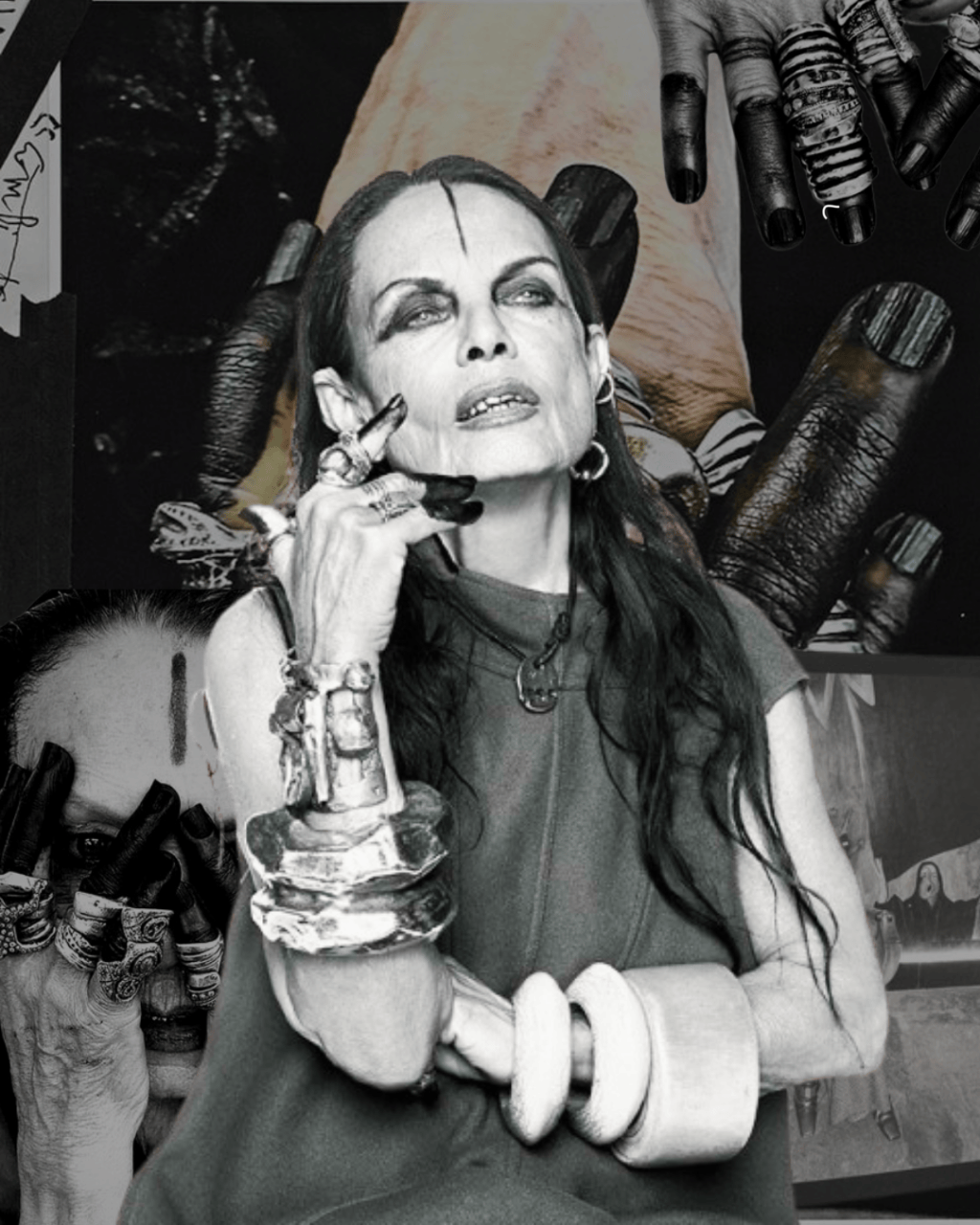
Issued by the Editorial Board, Fashion Law IP Blog.
Fashion has spent much of its history trying to make strangeness profitable. It takes what looks unfamiliar, gives it a runway, attaches a price to it, and eventually teaches consumers to call it desirable. Michèle Lamy did something more complicated. She did not simply make strange clothes. She made strangeness itself into a creative method.
Her career refuses the conventional chronology of fashion. Before becoming one of the most recognisable figures in the universe surrounding Rick Owens, Lamy had worked across radically different worlds: law, performance, nightlife, clothing, restaurants, design and art. She did not progress neatly from one profession to another. Instead, she accumulated them, allowing each to influence the next.
This is precisely what makes Lamy significant to fashion history. Her contribution cannot be understood solely through garments or collections. She represents a broader conception of fashion as an environment: something built through bodies, spaces, relationships, music, food, architecture, performance and identity. Her influence on Rick Owens is inseparable from this approach, but her own creative history began long before the Owens universe became internationally recognisable.
Lamy therefore made fashion strange not by abandoning fashion, but by repeatedly asking what else fashion could be.
A Life Outside the Expected
Born in France and raised in the Jura region, Lamy grew up around the production of fashion accessories through her family. Her early adulthood, however, did not follow the predictable route of a future fashion entrepreneur. She studied law and worked as a lawyer before moving through the worlds of political activism, performance and nightlife. Her experiences during the political turbulence surrounding May 1968 also contributed to an enduring interest in resistance and unconventional forms of expression. In later interviews, Lamy has described these experiences alongside her fascination with thinkers such as Gilles Deleuze and the possibilities of creative freedom. Her relationship with fashion consequently emerged less as a conventional career choice than as an extension of an already restless identity.
In 1979, Lamy moved to Los Angeles. She initially arrived in connection with her family’s eyewear business, but quickly discovered a practical problem: she could not find clothes that reflected the way she wanted to dress. Her response was not to search harder. She began making clothes herself.
According to Lamy, she developed a highly elastic fabric inspired partly by Sonia Rykiel’s knitwear and eventually secured exclusive rights to manufacture it. The resulting clothing business, Lamy, grew considerably, with the label being sold through major American department stores. By the mid-1980s, the company employed around a dozen people. This first chapter is important because it complicates the image of Lamy as merely a muse or cultural provocateur. She was already a designer and entrepreneur capable of building a functioning fashion business before Rick Owens entered her professional life.
Enter Rick Owens
Owens entered Lamy’s world in Los Angeles in the early 1990s, initially as a pattern cutter. Their introduction came through the city’s underground creative and club scenes, including the world surrounding fetish photographer Rick Castro. Owens had trained in pattern-making and was working within Los Angeles’ garment industry when he was introduced to Lamy. The relationship that followed would become one of the most consequential creative partnerships in contemporary fashion.
Yet it is important not to reduce the story to the familiar narrative of Lamy “discovering” Owens. Their own accounts are more complicated. Owens has acknowledged that Lamy already possessed a distinct vision and that his arrival eventually pushed the company in directions she had not intended to pursue. Lamy herself has jokingly suggested that Owens “killed” the Lamy label because his experimentation contributed to her losing interest in the business. The episode reveals something fundamental about Lamy’s creative personality: she was not necessarily interested in preserving a successful formula simply because it worked.
As Owens began experimenting with the materials available in Lamy’s studio, their relationship evolved from professional collaboration into an intimate and creative partnership. Owens would eventually establish his own label in 1994. Lamy’s influence, however, remained embedded in the environment from which the Rick Owens aesthetic emerged.
This is where Lamy’s relationship to fashion becomes particularly unusual. She did not simply become the designer behind a brand. She became part of the ecosystem that allowed a designer’s world to exist.
From Clothing to Hospitality
When Lamy’s clothing business declined, she did not simply leave fashion behind.
She moved sideways. Alongside her fashion activities, she entered hospitality, opening Café des Artistes and later Les Deux Cafés in Los Angeles. Les Deux, established in the mid-1990s, became a highly distinctive social environment where food, music, film, fashion and art converged. The restaurant was not merely a business. Lamy treated it as a form of cultural composition.
Its atmosphere was carefully constructed, and Lamy herself became part of the experience. The Los Angeles Times described her as a catalyst who brought together artists, actors and other creative figures. The restaurant’s significance therefore came not only from its food or interiors, but from the social world Lamy created around it. This is one of the clearest examples of why the conventional distinction between fashion and other creative disciplines fails when applied to Lamy.
She approached a restaurant in much the same way a fashion designer might approach a collection: by assembling people, objects, textures, spaces and moods into a coherent environment. The clothes were only one part of the world.
Making Rick Owens a World, Not Just a Label
The move to Paris in 2003 marked another major transition. Owens’ independent label was developing an increasingly distinctive identity, while Lamy became an important business and creative force within the enterprise that eventually developed into Owenscorp. Their partnership extended beyond fashion design into the construction of an entire aesthetic universe.
Lamy’s role has frequently been described through the language of muse, collaborator or business partner. Each term captures something, but none is sufficient. She has helped shape the environment in which Rick Owens operates. From business and production to image, cultural relationships, furniture and artistic collaborations.
This distinction matters because the fashion industry often privileges the visible author, the person whose name appears on the label. Lamy represents another form of creative labour. World-building.
A fashion house does not consist only of garments. It consists of spaces, images, rituals, personalities, objects, music and cultural associations. Lamy’s contribution lies substantially in constructing those relationships.
When Fashion Became Furniture
This expanded understanding of fashion became especially visible when Lamy and Owens entered furniture.
Beginning in the mid-2000s, the pair developed a furniture practice that transformed the materials and visual language associated with their fashion world into objects and environments. Owens provided designs, while Lamy became deeply involved in sourcing materials and overseeing fabrication. Their furniture was subsequently presented through galleries and museums, including a major exhibition at the Museum of Contemporary Art in Los Angeles in 2016–17. The transition from clothing to furniture might appear, at first, to be a departure from fashion. For Lamy, it was not.
It was another expansion of the same question: What happens when an aesthetic is no longer confined to the body?
A garment surrounds a person. Furniture surrounds a room. A restaurant surrounds a social encounter. A performance surrounds an audience. Lamy’s work repeatedly moves between these scales.
Her practice therefore challenges the assumption that fashion’s boundaries are defined by clothing.
The Body as a Creative Language
Lamy’s own appearance has also become inseparable from her cultural identity. Her distinctive clothing, jewellery, makeup, tattoos and physical presentation have made her recognisable independently of the fashion house with which she is associated. But treating this merely as eccentric styling would miss the larger point.
Lamy uses the body as a medium. Her appearance does not simply accompany her professional work; it communicates the same principles found throughout her career: resistance to conventional polish, fascination with materiality, theatricality, cultural collision and an unwillingness to separate everyday life from artistic expression.
This helps explain why Lamy has become such a powerful figure within fashion culture despite not being primarily known for designing conventional seasonal collections. She embodies an alternative model of fashion authority.
Where Fashion Ends and Everything Else Begins
In recent years, Lamy’s practice has continued to move between fashion, art, performance, activism, hospitality and cultural production. Her collaborations have extended into exhibitions, installations and projects with artists and younger creative communities.
Her relevance was formally acknowledged in 2026 when she received a Lifetime Achievement Award at the Fashion Trust U.S. Awards. Her continued cultural presence demonstrates how significantly her influence has expanded beyond the conventional boundaries of the fashion industry. Yet describing Lamy as simply an “icon” risks flattening what makes her interesting.
Her importance lies in the fact that she has consistently resisted the categories through which fashion history is normally organised.
She was a lawyer who became a performer, a performer who became an entrepreneur, an entrepreneur who became a designer, a designer who became a restaurateur, a restaurateur who became a cultural host, and a fashion entrepreneur who helped build one of contemporary fashion’s most recognisable aesthetic worlds.
The chronology looks chaotic only if each profession is treated as separate. Seen differently, it becomes remarkably coherent.
Why Michelle Lamy Made Fashion Strange
Lamy made fashion strange because she refused to treat fashion as an isolated discipline.
She brought the underground into luxury, hospitality into fashion, performance into identity, furniture into clothing culture and personal philosophy into brand construction. Her relationship with Rick Owens became one of the most visible expressions of this philosophy, but it should not obscure the fact that Lamy’s own creative vocabulary preceded and helped shape that partnership. Her significance also lies in the questions her career raises about authorship.
Who creates a fashion world, the person who sketches the garment, the person who produces it, the person who builds its spaces, the person who assembles its community, or the person who gives the entire system its cultural meaning? Lamy makes the question difficult because she occupies several of these roles simultaneously. That is why “strange” is not merely an adjective attached to her aesthetic. It describes the way she operates. She does not move from fashion into art, or from fashion into hospitality, or from fashion into furniture.
She makes the boundaries between them increasingly difficult to see. And perhaps the more important question is not why Michelle Lamy made fashion strange, but what happens when one person refuses to remain confined to any single definition of what a creative life, or fashion itself, can be.
References
1. Michèle Lamy, ‘The Making of a Maison’ (Rick Owens, October 2023).
2. Rick Owens, ‘My First Job in Fashion’ (Rick Owens, 22 January 2025).
3. Michèle Lamy and Helen Molesworth, ‘Michèle Lamy and Helen Molesworth in Conversation’ (Museum of Contemporary Art, Los Angeles, 18 December 2016).
4. Rebecca Matalon, Rick Owens: Furniture (Museum of Contemporary Art, Los Angeles 2016).
5. Lafayette Anticipations, ‘Michèle Lamy’ (Fondation Galeries Lafayette).
6. Lafayette Anticipations, ‘Lavascar’ (Fondation Galeries Lafayette).
7. Lafayette Anticipations, Au-delà: Rituels pour un nouveau monde (Fondation Galeries Lafayette 2023).
8. Giulia Di Giamberardino, ‘Les mille et une vies de Michèle Lamy, ex-avocate devenue icône de la mode’ (Vogue France, 29 July 2025).
9. Nathalie Olah, ‘Michèle Lamy’ (MAC Cosmetics, 10 July 2015).
10. ‘Where is Rick Owens in MOCA’s “Rick Owens: Furniture”? Ask Michèle Lamy’ (Los Angeles Times, 17 December 2016).
11. ‘Michèle Lamy, le bon génie du créateur Rick Owens’ (Le Monde, 13 April 2018).
12. ‘Michèle Lamy on Deleuze, Hollywood, and Her Brutalist Approach to Design’ (PIN–UP, 2016).
13. ‘2026 Fashion Trust U.S. Award Show’ (Fashion Trust U.S., 7 April 2026).
14. Fashion Trust U.S., ‘Michèle Lamy’ (Fashion Trust U.S. 2026).
15. ‘The Vestoj Storytelling Salon’ (Lafayette Anticipations, 5 April 2014).


Leave a comment