
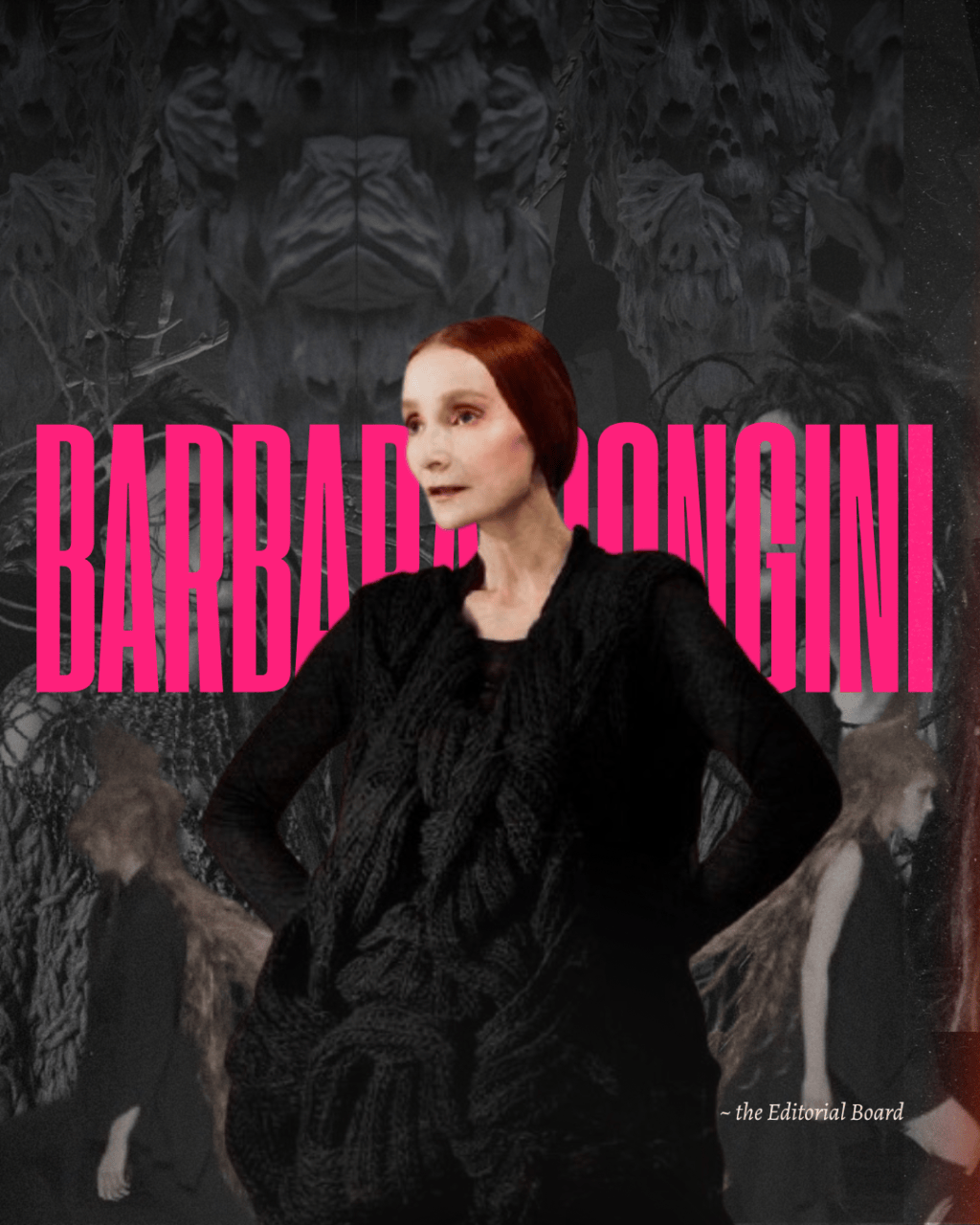
Issued by the Editorial Board, Fashion Law IP Blog.
Imagine trying to sell something that looks as though it was never designed to sell. There is no obvious glamour to decode. No insistence that the body should look smaller, longer, younger or more desirable. Black appears again and again, but rarely as a simple colour choice. Shapes distort, layers collapse into one another, and garments seem capable of changing their relationship with the body depending on how they are worn. It is an odd proposition for fashion.
Fashion is, after all, an industry built on desire. It creates things we did not know we needed and then gives us reasons to need them quickly. Seasons replace seasons, trends replace trends, and even rebellion eventually acquires a price tag. Against that logic, Barbara Gongini has spent much of her career developing a practice that appears deliberately difficult to consume in the conventional sense. Her work is commercial in the most literal sense. There is a label, there are collections, there are customers and there is a market. Yet the design language itself repeatedly resists the expectations that usually accompany fashion as a commercial product.
That tension gives her work its particular interest from an intellectual property perspective. If a designer becomes recognisable through a particular way of thinking about clothing rather than through one immediately identifiable object, what exactly does the law protect? A garment can potentially be protected. A logo can be protected. An original artistic work can attract copyright. But can intellectual property protect the broader visual language through which a designer becomes recognisable? Gongini’s career offers an unusually useful way of asking that question.
What if the clothes were never meant to behave?
Gongini was born in the Faroe Islands and graduated from the Danish Design School in 1996 before establishing her eponymous label in 2005. The geographical setting is relevant, although it should not be turned into a convenient explanation for everything that followed. Her work has often been discussed in relation to the Faroese landscape, its weather, darkness and natural environment, but the importance of that background lies less in direct visual translation than in the atmosphere it provides for a design practice concerned with protection, movement, layering and the relationship between the body and its surroundings.
Her early experiments were already distant from the polished logic of conventional fashion production. In accounts of her practice, Gongini has spoken about using leftover materials and scraps from earlier art projects. This relationship with existing material would become consistent with a broader interest in longevity and what she later described through the idea of “wardrobing”: clothing conceived to remain relevant and capable of being used in different ways rather than becoming obsolete with the arrival of another season. The point is not simply that she used discarded material. More interestingly, she questioned the assumption that fashion must continually produce something new in order to remain desirable.
This is where the idea of being “uncommercial” begins to make sense. Gongini does not appear to reject commerce itself. Instead, her work questions the commercial assumptions that often determine what fashion is expected to look like, recognisable categories, predictable silhouettes, gendered divisions, seasonal novelty and the pressure to make a garment immediately legible as desirable. Her clothes can be sold precisely because they refuse to be designed entirely around those expectations.
From the Faroe Islands to a fashion language
There is a significant difference between having a distinctive aesthetic and developing a recognisable design language. The former can describe a recurring visual preference. The latter suggests something more developed: a system of choices that continues to produce different objects while allowing those objects to be recognised as belonging to the same creative world.
Gongini’s work repeatedly returns to asymmetry, oversized proportions, layered construction, dark palettes, unconventional silhouettes and garments that do not necessarily prescribe one fixed way of being worn. Her approach to gender also complicates the traditional organisation of fashion. Rather than treating menswear and womenswear as rigid categories, the work tends to place greater emphasis on the individual and on the possibilities contained within a garment itself.
That distinction matters because a design language is rarely reducible to one feature. Black is not Gongini’s property. Neither is an oversized silhouette, asymmetry, draping or gender-neutral clothing. None of these elements, taken separately, can reasonably become the legal boundary of her creative identity. What makes the work distinctive is the way such elements are selected, combined and repeatedly developed across different collections and media.
Gongini has also described an approach in which shape and form are explored directly through draping on a mannequin. This is important because it shifts attention away from clothing as a flat visual composition and towards clothing as something constructed through the body. A garment is therefore not simply an image translated into fabric. It becomes a relationship between material, form, movement and wearer. The resulting object may have a fixed physical form, but its visual effect can change depending on how it is worn.
When a garment refuses to stay in one form
Multifunctionality creates an interesting contradiction for fashion law. Commercial fashion usually depends upon identifying the product: this is the jacket, this is the dress, this is the shoe. Gongini’s work often complicates that certainty. A garment may be wrapped differently, layered differently or positioned differently on the body, producing another silhouette without necessarily becoming another garment.
From a design perspective, this creates possibilities. From an intellectual property perspective, it raises a more difficult question about where the protectable object begins and ends. The law defines “design” through features of shape, configuration, pattern, ornament or composition of lines or colours applied to an article and judged solely by the eye, subject to statutory exclusions. It is therefore capable of recognising visual characteristics embodied in a particular article, but that does not mean that every idea behind a garment becomes proprietary.
The distinction between the idea and its particular expression becomes especially important in fashion. A designer may develop the concept of a garment that can be worn in several ways. Another designer cannot necessarily be prevented from independently arriving at the same general idea. But if the second designer reproduces a specific protected design, or copies an original artistic expression in circumstances where copyright protection applies, the legal analysis changes. The law does not ask simply whether the second garment “feels like” the first designer’s work.
This is one of the uncomfortable truths of creative industries. Recognition can be much broader than legal protection. A person can look at a garment and immediately associate it with a particular designer, while the law may still find that the individual elements are too commonplace to belong exclusively to anyone.
The law can protect the dress. Can it protect the thinking?
This is where Gongini’s career becomes particularly useful as a case study. Her creative identity is built through accumulation. One collection may contain a particular silhouette; another may reinterpret it through a different material; a later collection may change the proportion altogether while retaining the same underlying sensibility. Over time, these choices create recognition.
Intellectual property does not generally protect recognition as such. It protects particular legal interests. A registered design, an original copyright work, a trademark, or another identifiable subject matter falling within the relevant statutory framework. The broader aesthetic that emerges from the accumulation of those rights may have enormous commercial significance, but it is not automatically a proprietary asset in itself.
That gap is particularly visible in fashion because fashion is built on reference. Designers borrow from historical dress, subcultures, architecture, music, art, cinema and from one another. Silhouettes migrate between designers. Materials become trends. Styling conventions are repeated. A particular visual mood can become widespread without anyone being able to identify a single legal owner of it.
Gongini’s work therefore demonstrates why the question of copying cannot be reduced to similarity. Similarity is often inevitable. The more difficult question is whether the similarity concerns something the law recognises as protectable and whether the relevant legal requirements for infringement are satisfied. A designer may be deeply influenced by another designer without infringing their rights. Conversely, a reproduction can become legally significant even when the copying concerns only a particular protected expression.
The commercial value of refusing novelty
There is another contradiction running through Gongini’s work. Refusing conventional commerciality can itself become commercially valuable. Fashion has historically depended on novelty, but consumers do not necessarily need every garment they own to be new in the same sense. A piece that can remain useful, change shape, move between contexts and survive several seasons can acquire a different kind of value.
The use of old stock and leftover materials fits within this logic. So does the emphasis on multifunctionality. These decisions challenge the idea that sustainability in fashion must always be communicated through an obvious environmental aesthetic. A garment does not become sustainable merely because it is black, oversized or made from reclaimed material. The more interesting question is what kind of relationship the garment creates with time.
A disposable garment is designed around its replacement. A long-term garment is valuable partly because it resists replacement. Gongini’s practice places greater emphasis on the latter. In that sense, the “uncommercial” quality of the work may actually become one of its commercial strengths. The refusal to chase every temporary fashion expectation becomes part of the identity that customers are purchasing.
This also changes the way intellectual property functions commercially. A trademark may protect the name through which the customer identifies the label. Design rights can protect particular visual forms. Copyright may protect certain original artistic expressions. But the accumulated reputation surrounding the designer connects these rights to something larger: a creative identity that has been built over time.
From clothes to a world
Gongini’s work also extends beyond clothing. Photography, film, music, performance and visual presentation form part of the wider universe surrounding the label. That expansion matters because contemporary fashion brands rarely communicate through garments alone. The campaign image, runway presentation, soundtrack, website, packaging and social-media material can all become part of how the public understands a fashion house.
Each of those forms of expression may raise different legal questions. Photographs may involve copyright. Music brings another layer of rights. A logo or word mark can function as a trademark. A garment may raise design or copyright questions. Contracts determine who owns or may exploit commissioned creative work. The brand therefore becomes less like a single intellectual property asset and more like an ecosystem of rights.
For a designer whose work is immediately associated with a particular atmosphere, this ecosystem can be especially important. The commercial identity of the label does not reside solely in the physical garment. It is reinforced every time the same creative language appears across another medium.
When recognition outruns protection
Perhaps the most interesting feature of Gongini’s work is that the more recognisable it becomes, the harder it can be to identify one thing that explains that recognition. This is not necessarily a weakness. It may actually be evidence of a mature creative practice.
The law, however, needs specificity. It needs to know what right is being asserted, what subject matter is protected and what act allegedly interferes with that right. An aesthetic does not become a monopoly simply because it is distinctive. A mood cannot ordinarily be registered as a trademark merely because consumers associate it with one designer. A preference for black cannot become proprietary. Nor can the general idea of making clothing that is oversized, asymmetric, gender-neutral or multifunctional.
The practical consequence is that designers have to build protection around the elements that can actually be protected. The name of the label, its logos, original artwork, particular designs and contractual arrangements can each form part of a broader protection strategy. The creative language may remain larger than the individual rights, but those rights can help preserve the conditions in which that language has commercial value.
That distinction also protects the freedom of other designers to create. If every recognisable aesthetic became legally exclusive, fashion would become almost impossible to make. The industry depends upon influence, reinterpretation and transformation. Intellectual property has to draw a boundary between those legitimate creative processes and conduct that crosses into infringement.
The art is in the contradiction
Barbara Gongini’s work is interesting precisely because it refuses a simple opposition between art and commerce. The clothes are made to be worn and sold, yet they resist many of the assumptions that normally make fashion commercially legible. They engage with sustainability without reducing themselves to a sustainability message. They question gender without requiring gender to disappear. They create recognisable identity without relying upon one fixed visual formula.
That contradiction also explains the title. To be “uncommercial” in Gongini’s case does not mean refusing to participate in the market. It means refusing to allow the market’s usual expectations to become the entire logic of design. The work creates commercial value partly through its resistance to disposability, predictability and constant novelty.
For intellectual property, however, the contradiction remains unresolved. A designer can create a visual language that is unmistakable and still be unable to own that language as a whole. The law can protect the individual expressions through which a creative identity is constructed, but it does not necessarily protect the identity itself.
Perhaps that is where the tension between fashion and intellectual property becomes most revealing. Fashion asks us to recognise a designer through repetition, the recurring silhouette, the familiar proportion, the particular atmosphere. Intellectual property asks a different question, which of those things can the law actually recognise as belonging to someone?
Gongini’s career sits comfortably inside that gap. Her work demonstrates how a designer can become commercially identifiable without becoming legally capable of owning every element that makes the work identifiable. The designer becomes recognisable by remaining difficult to reduce.
And perhaps that is the real art of being uncommercial. It is not refusing to sell. It is refusing to let selling determine what the work must become. The harder question, for intellectual property, is what happens when a creative language becomes valuable precisely because everyone can recognise it, while nobody can easily own it.
References
- Barbara í Gongini, ‘Barbara í Gongini’, Lex.
- Claire Valentine, ‘Meet the Luxury Avant-Garde Nordic Designer Breaking Down Gender Norms’, PAPER Magazine (2017).
- Fashion Salad, ‘Barbara i Gongini’.
- ‘Un-compromised Fashion… Interview with BARBARA I GONGINI!’, Fucking Young!.
- Eluxe Magazine, ‘Designer Barbara i Gongini Interview: Rebel Heart’.
- Nordatlantens Brygge, ‘MUTATIONS — Barbara í Gongini & Hauge í Gongini Djernis’ (2022).
- Kristin Anderson, ‘Barbara í Gongini Copenhagen Fall 2016’, Vogue Runway (4 February 2016).
- Susanne Madsen, ‘Barbara í Gongini Copenhagen Fall 2015’, Vogue Runway (30 January 2015).
- Susanne Madsen, ‘Barbara í Gongini Copenhagen Spring 2016’, Vogue Runway (5 August 2015).
- World Intellectual Property Organization, ‘Intellectual Property in Fashion’.
- World Intellectual Property Organization, ‘Industrial Designs’.
- World Intellectual Property Organization, ‘Intellectual Property in the Fashion Industry’, WIPO Magazine (May–June 2005).
- World Intellectual Property Organization, ‘Does Copyright Protect Fashion?’, WIPO Magazine (March 2014).
- John Zarocostas, ‘The Role of IP Rights in the Fashion Business: A US Perspective’, WIPO Magazine (April 2018).
- World Intellectual Property Organization, Intellectual Property Rights in the Fashion Industry: From Conception to Commercialization (2023).
- World Intellectual Property Organization, Intellectual Property and Genetic Resources, Traditional Knowledge and Traditional Cultural Expressions (2020).


Leave a comment