
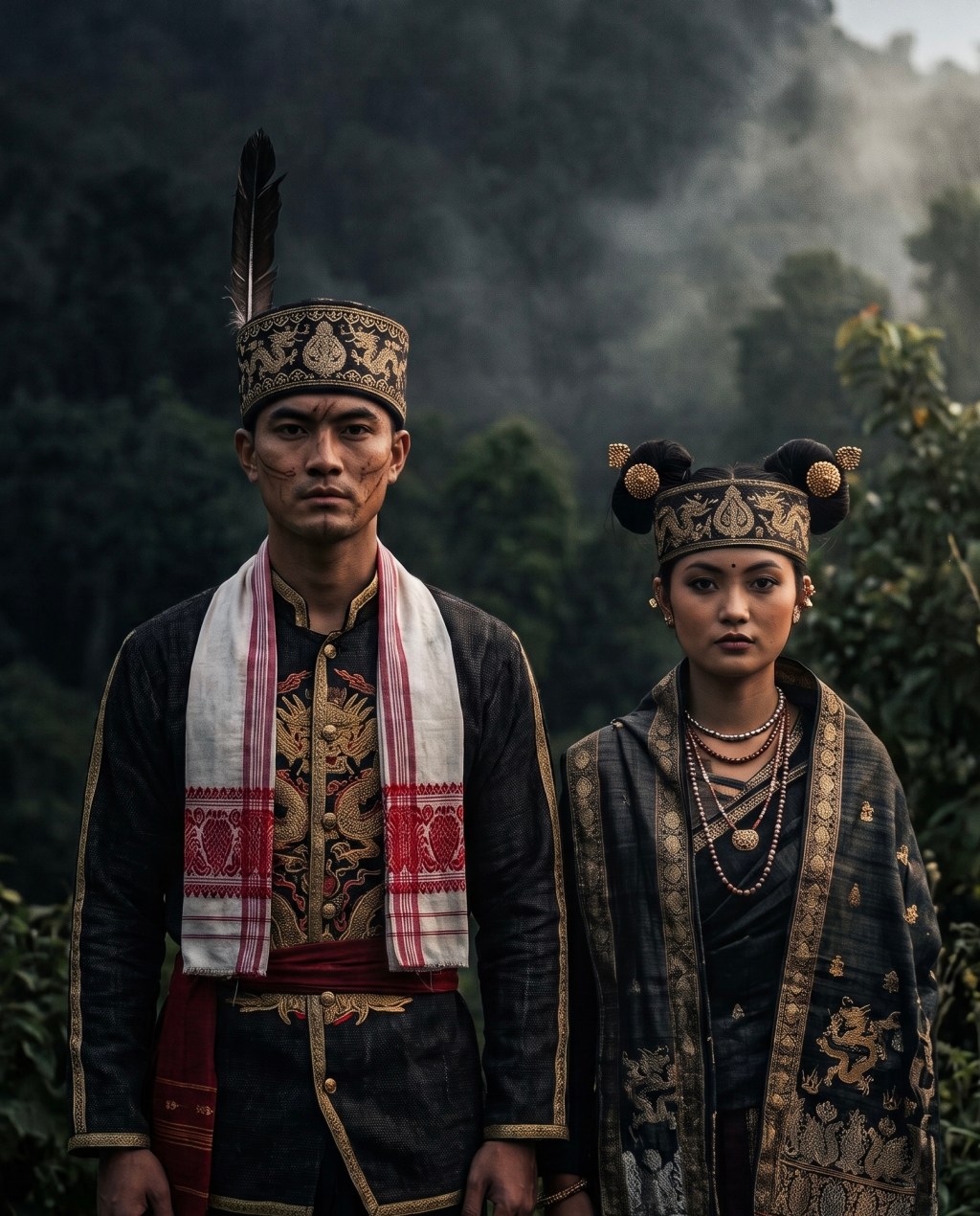
This article is authored by Aminesh Nayan Gogoi, Editor-in-Chief, and Antabikhya Gogoi, Research Head, Fashion Law IP Blog.
Clothing can preserve a history long after the language used to describe it has changed. A garment may survive in a museum, in a family’s memory, or on a contemporary fashion stage, yet the name attached to it may no longer tell its whole story. This is particularly important when discussing Tai-Ahom attire. Garments associated with the community are often described through familiar Assamese categories, but their names, construction, ways of wearing them, and cultural meanings point to a more specific tradition.
The distinction matters. Tai-Ahom attire is part of Assam’s wider textile history, but it should not disappear into the broader label of Assamese dress. The two traditions have influenced one another over centuries of coexistence, cultural exchange and assimilation. That shared history, however, does not make their garments identical. To understand Tai-Ahom clothing, it is necessary to look beyond the modern silhouette of the mekhela-sador and return to the garments and meanings preserved through community memory.
This article draws on an interview with Suprim Changmai Boruah of the Tai Ahom Students’ Organisation, Delhi, conducted on 8 October 2026. Boruah’s account provides community-specific descriptions of Tai-Ahom garments, distinctions between terms that are sometimes used interchangeably, and observations about historical textiles and their contemporary representation. These accounts are presented as oral testimony and are considered alongside published writing and museum material.
Black Before Gold: The Memory of an Older Attire
The history of Tai-Ahom attire is also a history of colour. In community accounts and historical discussions of Ahom clothing, black occupies a significant place. It is not simply a colour chosen for visual effect. It is remembered as part of an older mode of
dress, one that differed from the bright, golden image through which Assamese textiles are frequently represented today.
References to black clothing appear in discussions of the Buranjis, the historical chronicles of the Ahom kingdom. Suryya Kumar Bhuyan’s edited Assam Buranji provides a historical source for the study of the Ahom kingdom, although the specific passage and translation concerning black clothing should be checked before publication (Bhuyan 1945).
Boruah’s account of older Phasin garments similarly recalls black as a traditional colour. Black was also used alongside green or pink in some earlier combinations, according to his recollection (Boruah, interview by the authors, October 8, 2026). Today, Tai-Ahom garments are made and worn in a wider range of colours. Black-and-gold combinations have become more visible, while contemporary makers continue to reinterpret older designs.
The history of muga adds another layer to this story. Muga silk, known for its naturally golden appearance, is now closely associated with Assam’s textile identity. But the familiar prominence of gold should not lead us to assume that golden silk was always the defining feature of every Ahom garment. Historical accounts describe how muga silk production received substantial encouragement under Ahom royal patronage and how silk garments were associated with royal and elite use (Phukan 2012; Government of Assam, Directorate of Museum, n.d.).
Boruah also discussed Mejangkari silk, suggesting that it may have played a significant role in the motifs of upper garments worn by the Tai-Ahoms, although its precise historical use remains uncertain. The Silk Chamber describes Mejangkari as a silvery-white variety of Muga silk associated with Ahom kings and nobles. According to its account, the colour of the silk depends on the leaves fed to the silkworms, som and soalu leaves produce the familiar golden muga, while mejangkari or adakuri leaves yield a silvery-white filament. It further notes that Mejangkari silk was once prized in Assam but gradually declined in prominence. Read alongside Boruah’s recollections, this account raises the possibility that Mejangkari silk held a more significant place in Tai-Ahom textiles than is widely recognised today. Its precise use
in garment motifs, however, requires further historical verification (Boruah, interview by the authors, October 8, 2026; The Silk Chamber n.d.).
This is particularly relevant when Tai-Ahom garments are described through broader Assamese terms such as mekhela-sador, riha and cheleng-chador. While these terms reflect Assam’s shared textile traditions, they may not fully convey the distinct names, construction and cultural meanings of Tai-Ahom garments. Boruah’s account therefore encourages closer examination of the relationship between Mejankari, Muga and the textiles associated with Tai-Ahom attire (Boruah, interview by the authors, October 8, 2026).
This is an important distinction between an older clothing tradition and its later visual identity. Black and gold need not be placed in opposition. The history suggests a development in which an earlier association with black clothing was followed by greater use of silk, including Muga, in particular contexts. The evidence does not establish one uniform moment when every Tai-Ahom garment changed colour. Nor does it suggest that black disappeared completely. Rather, it invites us to see the present-day combination of dark fabric and golden motifs as part of a changing textile history.
The golden sheen of a garment can also obscure the differences between the fabric itself, the motif woven into it, and the social position of the person who wore it. Boruah observes that several historical garments in the images discussed during the interview appear to have a sheen consistent with silk. Their precise fibre content cannot be established from appearance alone. He also recalls that some forms of silk were expensive and associated with royal or elevated social use, while contemporary practitioners are attempting to revive older cultivation, production and weaving practices (Boruah, interview by the authors, October 8, 2026). These observations point to a history of textile knowledge that extends beyond colour and pattern.
The Garments Have Their Own Names
The clearest way to distinguish Tai-Ahom attire from the wider Assamese category is to begin with the garments themselves. Names carry knowledge of a garment’s shape, function, construction and place in social life. Replacing those names with a more
familiar label can make a garment easier to recognise to outsiders, but it can also erase the distinctions that make it culturally specific.
In Boruah’s account, the Phasüw is a shirt-like upper garment worn by both men and women. It is important to note that “pha” means cloth and “süw” means upper body in Tai, so “Phasüw” directly translates to “cloth for the upper body”. He describes it as having long sleeves, an Asian-style collar and frog-button fastening, with a cut that covers the upper body. He distinguishes this garment from the blouse commonly worn with the contemporary Assamese mekhela-sador, particularly where the blouse has a shorter cut or leaves more of the midriff exposed (Boruah, interview by the authors, October 8, 2026).
The distinction is not a claim that all Assamese blouses follow one pattern or that every Tai-Ahom community has always worn the same Phasüw. Clothing changes across periods, places and social groups. The point is that the Phasüw has a particular form and name that should not be lost when it is represented simply as a blouse.
The Phasin, also referred to as Sin in Boruah’s account, is a women’s lower garment. Similar to Phasüw, here, “pha” means cloth and “sin” means lower body, translating to “cloth for the lower body”. Its function may be compared to that of the mekhela, but Boruah distinguishes it by its construction. It is unstitched and, in the form he describes, has one prominent pleat at the front. This is a meaningful visual and structural difference. The contemporary mekhela is also an unstitched lower wrap, but its arrangement and pleating may vary. The comparison should therefore be made through the particular garment and method of draping, not through an assumption that every mekhela looks the same (Boruah, interview by the authors, October 8, 2026).
The distinction between the Phasin and the mekhela is especially important when historical textiles are catalogued. Boruah discussed a garment in a collection in the National Museum, New Delhi whose label identifies it using the Assamese terms sula and mekhla. He questions whether the label fully captures the garment’s identity, pointing to its prominent front pleat, colours and motifs as features that he considers consistent with Tai-Ahom attire. A label alone cannot settle the question of cultural origin, but neither should a familiar regional term be treated as a complete description.
The garment’s provenance, construction, textile technique and community history all matter (Boruah, interview by the authors, October 8, 2026).
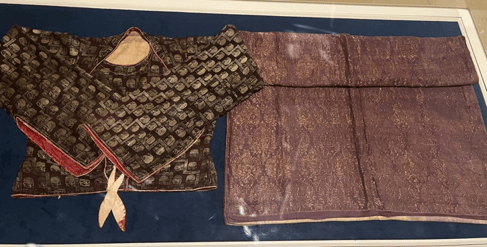
The upper-body cloths described by Boruah make the need for precise naming even clearer. Phamai, also called Seleng in his account, is a cloth worn across the chest (“mai” meaning “chest” in Tai). He notes that men may also wear it and that its manner of wearing is associated with Tai practice. Phadai, also called Langwat (“lang” meaning “back” and “wat” being a synonym for “cloth”), is different. Boruah describes it as a cloth worn by married women above the Phasin and associated with marital status (Boruah, interview by the authors, October 8, 2026).
These terms should not be used interchangeably. In Boruah’s account, Phamai refers to the chest cloth, while Phadai or Langwat carries a particular social association. He also cautions that some contemporary depictions identify a riha worn with a jacket as Phamai or Phadai, although the garments and their meanings are not necessarily the same. This distinction is important because the visual similarity of two pieces of cloth does not establish that they serve the same purpose (Boruah, interview by the authors, October 8, 2026).
Boruah further suggests that the riha became part of women’s attire through cultural exchange with neighbouring communities, including the Kacharis, and through the wider assimilation of Tai-Ahom dress into Assamese society. He stated that a different cloth had earlier served as a marker of marital status. This is an account that requires further historical corroboration, rather than a settled claim about the origin of the riha. It nevertheless raises an important question: when garments move between communities, how do their names, functions and meanings change? (Boruah, interview by the authors, October 8, 2026).
The other garments in Boruah’s account broaden the picture beyond women’s clothing. Kangkaen is described as a loose, flared, trouser-like lower garment for men. Saai Aeng is a male waist cloth or cummerbund. Pha-Ho or Pha-Ru refer to two styles of headgear worn by both men and women. According to Boruah, these are made by wrapping and arranging cloth around the head rather than by using a pre-formed, machine-made structure (Boruah, interview by the authors, October 8, 2026).
These descriptions show why Tai-Ahom attire cannot be understood through a single garment. Its identity lies in a system of clothing. The cut of the upper garment, the arrangement of the lower wrap, the distinction between chest cloths, the use of a waist cloth, and the ways cloth is folded or wrapped around the head. The names are not decorative additions to a familiar Assamese outfit. They are part of the knowledge through which the garments are understood.
A Shared Textile History, Not an Interchangeable One
Published studies of Tai-Ahom dress have sometimes described women’s attire through terms such as mekhela-chador, cheleng-chador and riha. Mouchumi Phukan’s study of Tai-Ahom dress, for example, discusses these garments while examining changes in the community’s clothing traditions (Phukan 2018, 2288–91). Such descriptions place Tai-Ahom clothing within the textile culture of Assam, where centuries of interaction have shaped how people dress and how garments are named.
But a broad classification can hide distinctions within it. If a Phasin is called a mekhela without any further explanation, the name may communicate its general function while leaving out the particular construction described by Boruah. If a Phamai or Phadai is called a riha without explaining its form and social use, the label may flatten differences that remain meaningful to the community.
The relationship between Tai-Ahom and Assamese attire is therefore not best understood as a choice between complete separation and complete sameness. Tai-Ahom clothing has contributed to the wider textile traditions of Assam, while Tai-Ahom dress has also changed through contact with other communities. The problem begins when the shared category becomes the only category, and the more specific garment name disappears.
The same concern applies to historical garments now held in museums. Boruah discussed two Phasins from the Bokota region of Sivasagar, a male garment preserved at Auniati Satra that he identifies as having been worn by Ahom king, Gadadhar Singha, and a garment in the Assam State Museum in Guwahati. (Boruah, interview by the authors, October 8, 2026; Government of Assam, Directorate of Museum, n.d.).
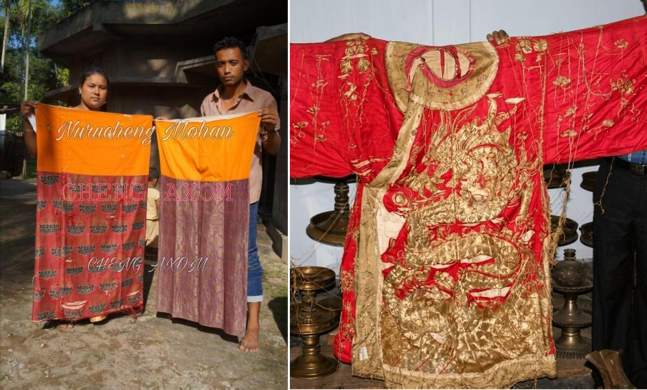
In discussing the photographs, Boruah draws attention to black, dark purple, maroon and deep red fabrics. He also identifies a motif on a dark purple garment in the Delhi museum image as Kingkhap, which he associates with royal Ahom dress and the clothing of noblewomen. He believes related motifs appear, sometimes only in part, across other garments in the material discussed (Boruah, interview by the authors, October 8, 2026).
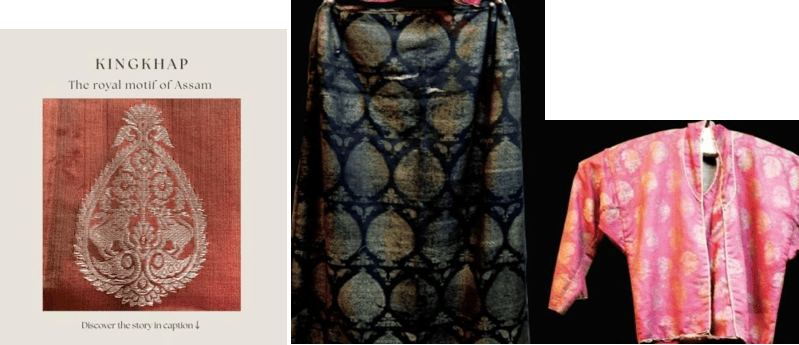
These observations are valuable starting points for research, but the attribution of an individual motif requires evidence beyond visual resemblance. Museum records, textile analysis, historical descriptions and consultation with knowledgeable practitioners can help establish how the motif was named, where it was used, and whether its meaning changed over time. A motif’s presence on a garment does not, by itself, prove that it originated in one community or belonged exclusively to it.
The importance of these objects lies partly in what they reveal and partly in what remains uncertain. A museum catalogue may record the name supplied when an object entered a collection. It may not record the name used by the community that made or wore it, the method by which it was woven, or the social context in which it was used. Re-examining the object with community knowledge can add information that the original description did not preserve.
The Knowledge Behind the Cloth
A garment does not emerge from a design alone. Its material, weave, dye, construction and method of wearing depend on knowledge passed between people. Boruah notes that some Tai-Ahom communities continue to make garments using inherited designs, while much contemporary production follows newer practices. He identifies communities associated with weaving and traditional knowledge, including Mohung, also rendered Mohan, Deodhai, Bailung, Chawrok, Chowkhun and Chaosinglung. These names and the specific roles associated with them should be confirmed with the interviewee before publication (Boruah, interview by the authors, October 8, 2026).
Boruah also recalls that knowledge of silk production and textile-making has been lost or weakened in some areas, while contemporary designers and practitioners are attempting to revive cultivation, silk production, motifs and weaving techniques. The particular silk varieties and the names used for them in the relevant community require further verification. The distinction matters because muga, pat, eri and other silks are not interchangeable materials, and a fabric’s appearance cannot conclusively identify its fibre (Boruah, interview by the authors, October 8, 2026; Phukan 2012).
The work of revival involves more than reproducing a pattern. It may require recovering the name of a garment, learning how it is draped, understanding the occasion for which it was worn, identifying the people who traditionally made it, and documenting the materials and techniques involved. Without this context, a recreated garment may look familiar but communicate little about the tradition from which it draws.
The same principle applies to the black-and-gold palette associated with many contemporary representations of Ahom attire. The combination may draw on historical memories of black clothing and the later significance of muga silk, but the relationship should be explained rather than assumed. Otherwise, a complex history of changing materials, courtly patronage and everyday clothing becomes a fixed visual formula.
What Happens When a Garment Loses Its Name?
The distinction between Tai-Ahom attire and the wider Assamese category is not merely a question of terminology. It concerns who gets to describe a cultural object and whose knowledge is preserved when that description becomes authoritative.
A museum catalogue, fashion publication or commercial collection can make a garment visible to a wider audience. It can also give the garment a name that becomes widely repeated, even when that name leaves out its community-specific history. The consequences may be subtle. a Phasin becomes only a mekhela, Phamai and Phadai become interchangeable. A traditional way of arranging a headcloth is reduced to a styling detail. The garment remains visible, but the knowledge that distinguishes it becomes harder to find.
This is not an argument against shared Assamese identity or against cultural exchange. Nor does every garment have one uncontested origin or an unchanging meaning. The histories of clothing are often histories of movement, adaptation and borrowing. But exchange is easier to understand honestly when the communities involved, the names they use and the meanings they attach to garments are recorded rather than absorbed into a single regional label.
For that reason, documenting Tai-Ahom attire should begin with the community’s own terminology and the particular details of each garment. Where historical records use a broader Assamese name, that name can be retained alongside a more specific
description, provided the evidence supports it. Where oral testimony offers a different interpretation, it should be attributed and investigated. Uncertainty should be recorded instead of concealed behind a confident label.
Protecting the Right to Remember
Intellectual property law offers some tools for protecting contemporary textile designs, original artistic works and certain forms of collective commercial identity. But these legal categories do not automatically recognise every form of inherited cultural knowledge. A contemporary designer may create a new work inspired by a traditional garment, while the older garment’s name, method of wearing and community history remain inadequately documented.
Copyright Act 1957 protection depends on the nature of the work and statutory requirements, while the Designs Act 2000 may protect qualifying new designs. The Trade Marks Act 1999 may protect eligible marks, including collective and certification marks. The Geographical Indications of Goods (Registration and Protection) Act 1999 may apply where a garment or textile’s quality, reputation or characteristics are essentially attributable to a specific geographical origin (s 2(1)(e)).
GI protection may therefore be possible if the required geographical link is established, but it cannot automatically protect an entire cultural tradition, a garment style or a motif without satisfying the statutory criteria.
This limitation makes careful documentation important, even where documentation cannot itself settle a question of ownership. Recording the names Phasüw, Phasin, Phamai, Phadai, Kangkaen, Saai Aeng, Pha-Ho or Pha-Ru, together with their construction and use, helps preserve distinctions that may otherwise disappear from public accounts. Recording who supplied the information also makes it possible to return to the source, seek clarification and acknowledge community knowledge.
Documentation must nevertheless be undertaken responsibly. Publishing a motif or technique can help sustain recognition, but it may also make it easier for others to reproduce it without credit or consultation. Researchers and designers should consider how community members wish their knowledge to be represented, whether particular
information should remain restricted, and how any commercial use might acknowledge or benefit the people who have maintained the tradition.
The question is not simply whether an old garment can be protected by law. It is whether the cultural knowledge surrounding that garment can remain visible when it enters museums, scholarship, fashion and commerce.
The Garment Is More Than Its Silhouette
Tai-Ahom attire belongs to the history of Assam, but it cannot be adequately described by that relationship alone. The Phasüw is not merely a blouse, the Phasin is not fully explained by calling it a mekhela, and Phamai and Phadai should not be treated as two names for the same cloth. Their differences are carried through construction, draping, social use and community memory.
The history of colour tells a similar story. The remembered association with black, followed by the growing prominence of muga and its golden hue, challenges the idea that today’s familiar visual image has always represented the tradition in the same way. The garments, their materials and their meanings have changed, and those changes deserve to be recorded with care.
To recognise Tai-Ahom attire is not to remove it from Assamese culture. It is to recognise that Assamese culture contains distinct histories which should not be made indistinguishable in the name of a shared identity. A garment can belong to the wider history of a region while retaining the name and knowledge of the community that made it.
When clothing carries history, preserving the silhouette is only the beginning. The names, the hands that weave it, the ways it is worn, and the memories attached to its colours must survive with it.
Note: The attire depicted in the visuals accompanying this article represents a creative interpretation of historical Tai-Ahom clothing, developed from the sources consulted during our research. These visuals are intended for illustrative purposes and should not be taken as definitive historical reconstructions of Tai-Ahom attire.
References
- Bhuyan SK (ed), Assam Buranji, or, A Chronicle of Assam from the Earliest Ahom Kings to Swargadeo Gadadhar Singha: With Preface, Analysis and Introduction in English: From an Old Manuscript Obtained in the Family of the Late Srijut Sukumar Mahanta of North Gauhati (Government of Assam, Department of Historical and Antiquarian Studies 1945).
- Government of Assam, Directorate of Museums, Catalogue on Costumes of the Ahom Royalty (n.d.) https://museums.assam.gov.in/portlet-innerpage/catalogue-on-costumes-of-the-ahom-royalty
- Phukan M, ‘A Study on the Dress-Culture of the Tai-Ahoms of Assam’ (2018) 17(4) Elementary Education Online 2288.
- Phukan R, ‘Muga Silk Industry of Assam in Historical Perspectives’ (2012) 12(D9) Global Journal of Human-Social Science 5.
- Boruah SC, interview by the authors, Tai Ahom Students’ Organisation, Delhi (8 October 2026).
- Copyright Act 1957.
- Geographical Indications of Goods (Registration and Protection) Act 1999.
- The Silk Chamber. n.d. “Silver Muga Anyone?” The Silk Chamber.
- Designs Act 2000.
- Trade Marks Act 1999.


Leave a Reply